Monetizing Content for Brand Managers: A Revenue-First Playbook


The fastest path to content revenue generation is a revenue-first strategy: map every asset to buyer intent, then route engagement signals directly into your CRM for attribution. Start this week by (a) selecting the primary monetization model that matches your audience’s intent, and (b) configuring one content event to fire into HubSpot or Salesforce so you can track revenue impact immediately.
Pick your primary path first. Turtl’s revenue content playbook shows that feeding behavioral signals into CRM is the single most critical step brands skip.
Map before you produce. Sangria Tech frames this clearly: content mapped to buyer intent converts from a cost center into a measurable growth engine.
Vainnewyork applies this exact approach for creative brands, connecting content production to audience growth and measurable revenue outcomes.
Table of Contents
Which monetization models actually work for brands?
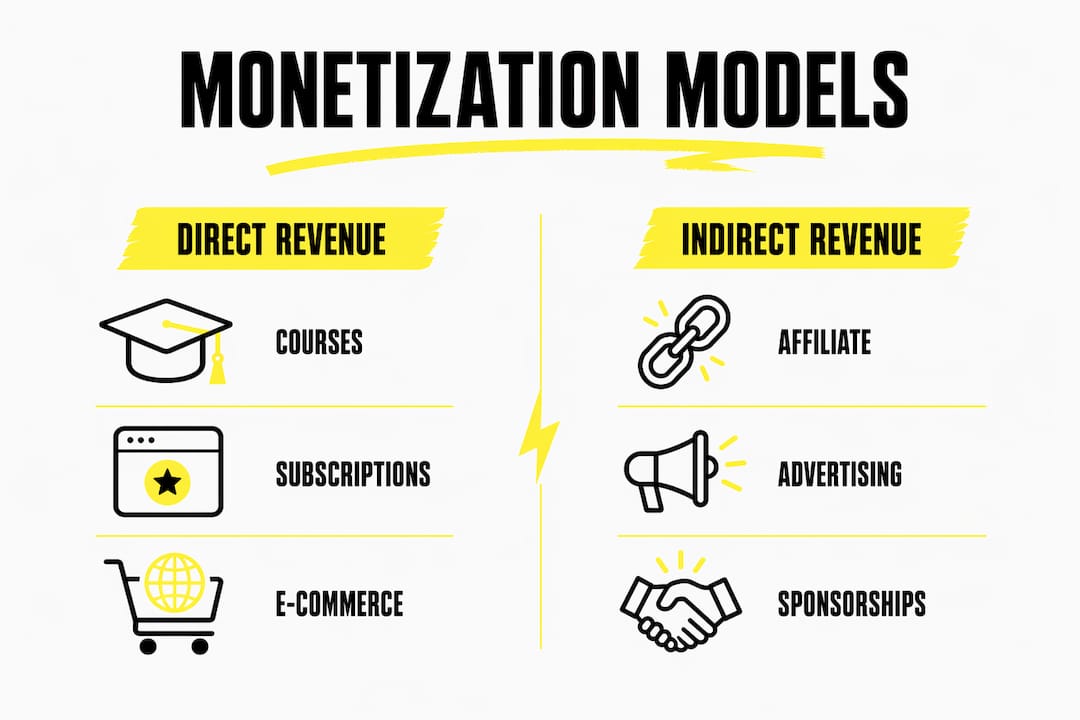
Not every model fits every brand. The six primary paths each carry different scale requirements, payout timing, and risk profiles.
Model | Best intent match | Time to first revenue | Scale requirement |
Display ads | Informational | Months | high traffic volume |
Affiliate/referral | Comparison, purchase-intent | Days to weeks | Any size |
Sponsorships/brand deals | Engaged niche | Weeks to months | a sizable engaged audience |
Commerce/product-led | Purchase-intent | Weeks | Email list |
Subscriptions/memberships | Loyalty, retention | Weeks | a core base of superfans |
Paid events/courses | Problem-aware, decision | Weeks | 500+ email subscribers |
Display ads require real traffic volume before they pay meaningfully. Affiliate commissions range from 1–4.5% on Amazon physical goods to 20–60% recurring on SaaS referrals, making affiliate the fastest starting point for most brands. Subscriptions and memberships, through platforms like Patreon and Substack, create predictable recurring income once a loyal core audience exists. Licensing and syndication add a quieter revenue layer: brands sell or license existing content to third-party publishers without producing anything new.
The creator economy exceeded $250 billion and most creators earning under $15K/year share one trait: single-stream dependence. Diversifying across two to three revenue streams is what separates stable brands from vulnerable ones.
Single-stream dependence is the most common failure mode. Algorithm shifts, platform policy changes, and ad-rate fluctuations can cut revenue overnight. Stacking a primary model with one or two secondary streams, for example, sponsorships anchored by an affiliate layer, protects against that volatility. For a deeper look at how content fits within paid and owned channels, Vainnewyork’s guide on media mix strategy is worth reading alongside this playbook.
How do you map content assets to buyer intent?
Every piece of content should have a declared intent stage and a monetization path attached before production begins. This is the discipline that separates brands that earn from content from those that simply publish it.
Buyer stage | Content type | Monetization fit |
Awareness | Long-form educational, video explainers | Display ads, sponsorships |
Consideration | Product comparisons, case studies | Affiliate links, brand deals |
Decision | Deep problem guides, demos, reviews | Commerce, membership offers |
Retention | Exclusive tutorials, community content | Subscriptions, upsell/cross-sell |
Mapping works in both directions. If you already have a strong affiliate program, audit your existing content for comparison and purchase-intent pieces and add tracked links retroactively. If subscriptions are the goal, the retention row tells you what to produce: exclusive, high-value content that casual visitors cannot access. Sangria Tech’s revenue-first framework reinforces this: sales enablement content at the decision stage shortens deal cycles when it reaches the right prospect at the right moment.
For a practical framework on aligning content with business objectives, Vainnewyork’s content strategy guide walks through the full planning process.
How do you measure the revenue impact of content?
Current marketing technology often fails to connect content engagement to revenue. The fix is straightforward: instrument content events and pipe them into CRM so sales teams can act on behavioral signals.
Step-by-step instrumentation checklist:
Define UTM parameters for every content channel (source, medium, campaign, content).
Set up custom events in your analytics layer (page scroll depth, video completion, document download).
Map each event to a CRM field (lead score increment, lifecycle stage change, pipeline stage update).
Configure lead scoring rules so high-intent content interactions trigger sales alerts.
Audit the data flow monthly to catch broken event fires or unmapped fields.
Content event | CRM field updated | Downstream metric |
Watched product demo | Lead score +20, stage → MQL | Pipeline velocity |
Downloaded buyer’s guide | Lead score +10 | Engagement-to-lead ratio |
Attended paid webinar | Stage → SQL, deal created | Revenue per asset |
Clicked affiliate link | Conversion tracked | Commission revenue |
Attribution approach: First-touch attribution credits the content that created awareness. Last-touch credits the asset that closed the deal. For content-led funnels, a hybrid model works best: give 40% credit to first touch, 40% to last touch, and distribute the remaining 20% across middle-touch assets. This prevents both overvaluing top-of-funnel content and ignoring the nurture pieces that move prospects forward.

How do you price and forecast revenue from content-led offers?
The unit economics are simple: revenue equals conversions multiplied by price. The complexity lives in churn and customer acquisition cost (CAC) for recurring models.
Set your price anchor. Show a higher-tier option first so the target price feels reasonable by comparison.
Run a pre-sale before full production. CreatorFlow recommends pre-selling digital products to validate demand before investing production resources.
Model three scenarios. Conservative, likely, and best-case conversion rates give you a realistic revenue band.
Worked example for a $49/month membership:
Conservative: 50 members × $49 = $2,450/month
Likely: 120 members × $49 = $5,880/month
Best-case: 250 members × $49 = $12,250/month
For a one-time course at $297: 30 sales in month one equals $8,910. CAC matters here. If paid acquisition costs $80 per buyer, the course is profitable from the first sale. If CAC runs $200, you need a back-end upsell to break even.
Pro Tip: Run a 72-hour pre-sale at a 20–30% discount to a warm email segment before committing to full course production. If fewer than 2% of your list buys, the topic or price needs rethinking before you invest production time.
What tech stack do U.S. brands need to monetize content?
The core stack has four layers, and the integration order matters as much as the tools themselves.
CMS: WordPress, Webflow, or a headless CMS with webhook support for event firing.
CRM: HubSpot for mid-market teams (native content tracking, lead scoring built in); Salesforce for enterprise teams needing deep pipeline attribution.
Analytics and tag management: Google Analytics 4 with Google Tag Manager for event instrumentation; no-code event setup reduces dependency on engineering.
Membership/paywall: Patreon or Substack for creator-style recurring offerings; MemberPress or Memberful for owned-site paywalls.
Payment processor: Stripe handles U.S. payment routing, subscription billing, and payout management with strong webhook support for CRM integration.
Integration priority order:
Connect CMS to analytics (GA4 + GTM events firing on key content interactions).
Connect analytics to CRM (HubSpot or Salesforce native connectors or Zapier/Make for custom flows).
Connect payment processor (Stripe) to CRM so purchase events update contact records automatically.
Add membership/paywall layer once the revenue-tracking foundation is solid.
For U.S. brands, sales tax on digital goods varies by state. Stripe Tax automates collection and remittance for most digital product categories, but confirm your specific product classification with a tax professional. For operational guidance on producing content at scale to feed this stack, Vainnewyork’s content creation guide covers the production side in detail.
Pro Tip: Choose platforms with native webhook support. A CRM that cannot receive real-time event data from your CMS or payment processor will always leave a revenue gap in your attribution.
What does a 90-day implementation roadmap look like?
Phase | Actions | Owner |
Days 1–30 | Audit content assets, select primary monetization path, configure one content→CRM event, define UTM taxonomy | Strategy lead, analytics |
Second month | Instrument full event set, launch first conversion test (pre-sale or soft paywall), set up lead scoring rules | Tech integration, content |
the third month | Analyze first conversion data, prepare membership or course MVP, establish sales handoff protocol for content-sourced leads | All roles |
Role matrix:
Strategy lead: owns monetization model selection and KPI framework.
Analytics: owns event instrumentation, CRM field mapping, and attribution reporting.
Tech integration: owns CMS/CRM/Stripe connections and tag management.
Content production: owns asset creation mapped to buyer-stage table.
Sales enablement: owns handoff rules and lead follow-up SLAs for content-sourced MQLs.
The governance rule between marketing and sales is simple: any contact who triggers a decision-stage content event (demo view, pricing page visit, course purchase) moves to sales ownership within 24 hours, with the content interaction logged in CRM as context.
What do successful content monetization examples look like?
Commerce/product-led example: A creative brand producing editorial video content added shoppable product links to each video description and embedded affiliate tracking. By mapping purchase-intent videos to affiliate links and routing click events into HubSpot, the team identified which video topics drove the highest conversion rates and doubled production of those formats.
Primary path: affiliate/commerce
Instrumented: video completion events, affiliate link clicks → CRM lead score
Key lift: conversion rate on purchase-intent content increased after removing non-converting formats
Subscription/membership example: A B2B content team launched a gated research library at $99/month. They pre-sold 60 memberships to their email list before building the full content archive, validating demand before committing production resources. Stripe handled billing; HubSpot tracked member engagement and flagged churn risk when login frequency dropped.
Primary path: subscription
Instrumented: login events, content consumption depth → churn risk score
Key lift: churn risk identification allowed proactive outreach before cancellation
Vainnewyork’s practical insight for creative brands: the fastest low-friction win is adding UGC monetization infrastructure to existing brand content. Brands pay for converting creative regardless of creator follower count, which means a well-instrumented content library can generate brand-deal revenue without requiring audience scale first.
What U.S. legal and tax essentials apply to monetized content?
FTC disclosures: Any sponsored content, affiliate link, or brand deal requires a clear, conspicuous disclosure (“Ad,” “Sponsored,” or “Paid partnership”) per FTC endorsement guidelines. Disclosures must appear before the affiliate link or sponsored mention, not buried at the end.
Sponsorship agreements: Use written contracts that specify deliverables, usage rights, exclusivity windows, and payment terms. A creator rate card formalizes pricing and protects both parties.
IP and licensing: Content sold or licensed to third parties requires a written license agreement specifying scope, territory, and duration. Work-for-hire arrangements transfer copyright to the client; licensing retains it with the creator.
Sales tax on digital goods: U.S. states vary widely on taxability of digital products, subscriptions, and online courses. Stripe Tax automates collection for most categories, but consult a U.S. tax professional for your specific product classification.
IRS reporting: Platform payouts above $600 trigger 1099-K reporting. Keep records of all content-related income and expenses for accurate Schedule C or business-entity filing.
This section is general information, not legal or tax advice. Confirm your specific obligations with a qualified U.S. attorney or CPA.
How do you run experiments to improve monetization over time?
A repeatable experiment structure prevents teams from guessing and lets data drive the next production decision.
Hypothesis: “Adding an affiliate link to our top 10 comparison posts will increase referral revenue by X% within 30 days.”
Audience: Organic search visitors to comparison-intent pages.
Metric: Affiliate click-through rate and commission revenue per page.
Variant: Affiliate link placement (inline vs. end-of-post vs. sidebar).
Sample size: Minimum 500 unique visitors per variant before reading results.
Duration: 30 days to account for weekly traffic variation.
Decision rule: If variant A generates 20% more commission revenue, roll it out site-wide.
KPIs every monetizing content team must track:
Revenue per asset (total revenue attributed / number of content pieces)
Conversion rate (content visitors who complete a monetization action)
Lifetime value (LTV) of content-sourced customers vs. other channels
Customer acquisition cost (CAC) for content-driven conversions
Engagement-to-lead ratio (content interactions that become CRM contacts)
Churn rate for recurring subscription or membership offers
Prioritize experiments that require the least production effort and touch the highest-traffic assets first. A placement test on existing content costs nothing to produce and can return data within weeks.
Key Takeaways
A revenue-first content strategy, built on intent mapping and CRM-connected measurement, is the most reliable path from content production to measurable income.
Point | Details |
Map content to buyer intent | Assign every asset an intent stage and a monetization path before production begins. |
Close the revenue gap with CRM | Route content engagement events into HubSpot or Salesforce to enable attribution and lead scoring. |
Diversify across two to three streams | Single-stream dependence leaves brands exposed to algorithm and platform shifts. |
Pre-sell before you build | Validate demand with a pre-sale before committing full production resources to a course or membership. |
Track revenue per asset | This single KPI reveals which content earns its production cost and which should be cut or repurposed. |
The tradeoff creative brands rarely talk about
The brands we admire most in creative culture built their audiences on generosity, not extraction. That tension sits at the heart of every monetization decision: the moment content starts optimizing for conversion, it risks losing the quality that made the audience worth monetizing in the first place.
The practical warning here is not to avoid monetization. It is to sequence it correctly. Build the audience with content that earns genuine trust, instrument the revenue layer quietly underneath, and resist the pressure to turn every asset into a sales vehicle before the relationship is ready for it. Over-optimizing for short-term revenue at the expense of brand equity is the most common mistake we see creative teams make, and it is almost always irreversible once the audience notices the shift.
The brands that sustain content revenue over years are the ones that treat monetization as a byproduct of genuine value creation, not the other way around. Vainnewyork’s work with creative brands consistently shows that the most durable revenue streams grow from content that the audience would miss if it disappeared.
Useful sources and further reading
Turtl: Revenue content playbook — measurement and CRM integration guidance
Sangria Tech: Revenue-first content strategy — intent mapping and sales enablement framework
AI Tools Guidebook: Monetization paths — RPMs, affiliate commission ranges, and path-fit guidance
CreatorFlow: Revenue stacking and pre-sales — validation and diversification approach
Influencer Marketing Hub: Creator business models — creator economy scale and diversification data
Stripe: Content monetization platforms — payment infrastructure and platform overview
Black X: Creator rate card guide — sponsorship pricing and contract structure
FTC endorsement guidelines — U.S. disclosure requirements for sponsored and affiliate content
Recommended
Comments