Content Creation: A Practical 2026 Guide for Marketers


Content creation is the strategic process of researching, planning, producing, and distributing digital media to engage specific audiences and achieve measurable business goals. The global creator economy has surpassed $250 billion, with approximately 207 million people worldwide identifying as content creators. That scale signals one clear truth: producing content without a system behind it means competing against professionals who have one. This guide gives you the workflow, tools, and measurement frameworks to build content that earns trust, ranks on search engines, and gets cited by AI platforms.
What does effective content creation require in 2026?
Effective content creation starts with knowing exactly who you are making it for. Audience profiles and personas define the problems your readers face, the language they use, and the platforms they prefer. Without that foundation, even well-produced content misses its mark.
A documented content strategy is no longer optional. It functions as an operational business asset, covering positioning, content taxonomy, an editorial calendar, and a governance RACI (a matrix defining who is Responsible, Accountable, Consulted, and Informed for each content decision). Brands that skip this step end up with content bloat: hundreds of pages that overlap, contradict, or simply age out without anyone noticing.

Entity authority mapping has replaced simple keyword lists as the strategic foundation. Rather than targeting isolated search terms, you define the credible expertise areas your brand owns. That mapping guides every topic decision and signals to AI search engines that your content comes from a genuine authority.
The brief template is the quality cornerstone of any production process. A highly structured brief specifies the target query, search intent, audience, desired outcomes, and key sources before a single word gets written. It aligns writers, designers, and strategists around the same goal.
Pro Tip: Build your brief template once, then make it mandatory for every piece. Teams that skip the brief spend more time in revision than in production.
Here is a practical overview of the core tools every creator and marketer needs:
Tool Category | Purpose | Examples |
Writing and editing | Draft, revise, and refine written content | Google Docs, Notion, Grammarly |
Video production | Record, edit, and publish video content | Adobe Premiere Pro, CapCut |
SEO and research | Keyword research, entity mapping, audits | Ahrefs, Google Search Console |
AI assistance | Drafting, ideation, and repurposing support | ChatGPT, Claude |
Analytics | Track performance across channels | Google Analytics 4, Hotjar |
Which content formats and workflows maximize engagement?
Format selection drives results more than production quality alone. Video content accounts for 82% of all internet traffic, making it the single most powerful format for reach. That does not mean every brand needs a film crew. It means video must appear somewhere in your content mix.
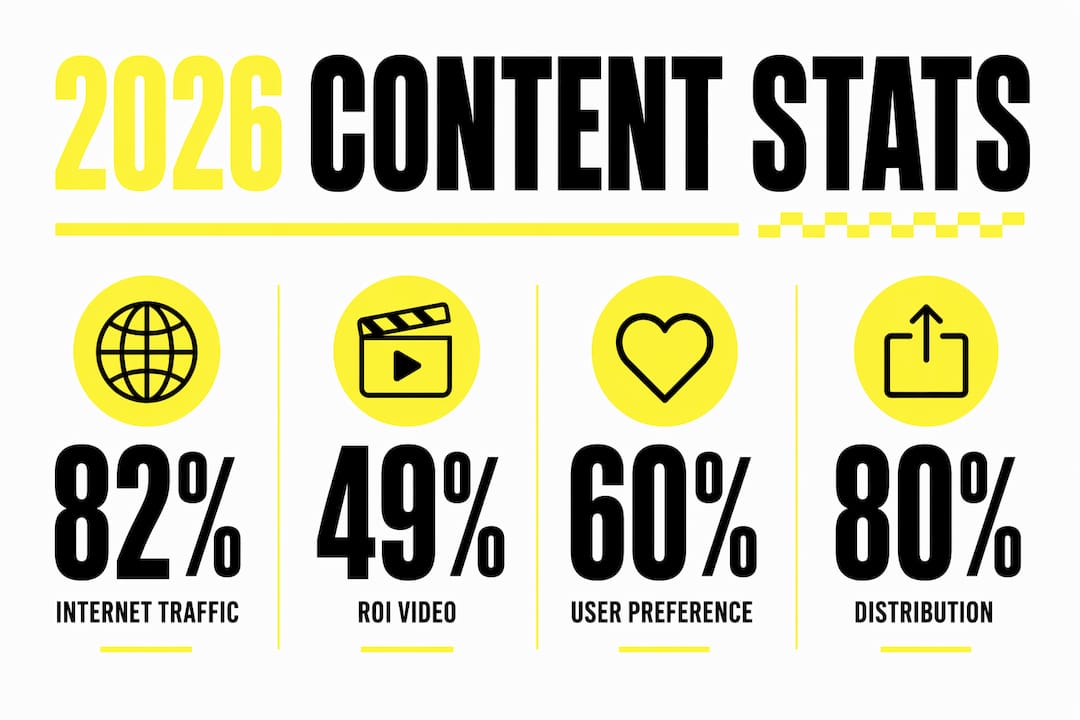
Short-form video under 60 seconds leads ROI for 49% of marketers and is the most-used format for 60% of practitioners. Long-form video, by contrast, drives deeper engagement and audience growth over time. The right choice depends on where your audience sits in the buying process: short-form captures attention at the top of the funnel, while long-form builds the trust that converts.
Written content, audio (podcasts and audiograms), and interactive formats (quizzes, calculators) each serve distinct purposes. Written content anchors SEO and AI citation strategies. Audio builds loyalty through repeated listening. Interactive content generates data and keeps readers on the page longer. A mature digital content development program uses all four, repurposing each piece across formats to multiply reach without multiplying workload.
The six-stage workflow below applies to every format:
Research. Define the target query, audience intent, and competing content. Map the topic to your entity authority areas.
Planning. Complete the brief template. Assign roles using the governance RACI. Set a publication date.
Production. Write, record, or design the content. Use AI tools for first drafts, ideation, and outline generation.
Review. Edit for accuracy, brand voice, and SEO alignment. Run a final brief check before approval.
Distribution. Publish on primary channels, then repurpose across secondary platforms. Schedule social promotion, email, and paid amplification.
Analysis. Track performance over a 60–90 day window. Feed findings back into the next research phase.
Content creation now breaks down to roughly 20% writing and production and 80% distribution, SEO, repurposing, and analytics. Most creators invert that ratio and wonder why their work goes unseen.
Pro Tip: Plan your distribution strategy before you start production. Knowing where a piece will live shapes how you write, film, or design it from the start.
How do you measure content creation success?
Measurement in 2026 runs on two parallel tracks. The first is traditional: organic clicks, time on page, conversion rates, and keyword rankings. The second is new: AI search engines evaluate topical depth, author credibility, and recency rather than link counts alone. Brands that only track Google rankings miss half the picture.
Reviewing performance over 60–90 day periods gives you statistically meaningful data. Weekly fluctuations in traffic are noise. Monthly trends are signals. Quarterly reviews reveal whether your entity authority is growing or stagnating.
Key metrics to track across both surfaces:
Organic traffic by page and topic cluster
Engagement rate (scroll depth, time on page, return visits)
Conversion rate from content entry points
LLM citation frequency (how often AI tools reference your content)
Brand authority signals (branded search volume, backlink growth)
Content decay rate (pages losing traffic quarter over quarter)
Content audits that categorize every piece as keep, update, consolidate, or retire are the most efficient way to manage a growing content library. Running this audit twice a year prevents the content bloat that buries your best work.
Pro Tip: Set up a shared audit spreadsheet with columns for traffic trend, last updated date, and audit decision. Review it every six months as a team, not just as an individual.
Metric | Review Cadence | Action Trigger |
Organic traffic trend | Monthly | Decline over two consecutive months |
Conversion rate by page | Quarterly | Drop below baseline by 15% |
LLM citation frequency | Quarterly | Zero citations in key topic clusters |
Content decay rate | Biannually | More than 20% of pages declining |
What content creation mistakes undermine results?
The most common mistake is producing content without a clear goal or audience understanding. Publishing a blog post because “we need more content” is not a strategy. Every piece needs a defined query, a target reader, and a measurable outcome before production begins.
Most practitioners fail not at creation but at the operating system layer. Missing governance frameworks, undefined taxonomies, and absent decision rights produce inconsistent quality at scale. One writer follows the brand voice guide. Another does not. The result is a content library that feels like it was made by ten different companies.
Overemphasizing volume over quality is the second most damaging pattern. Publishing five average posts a week generates less authority than publishing one exceptional piece. AI search engines reward depth and credibility. Thin content, no matter how frequently published, does not earn citations.
Neglecting distribution until after publication is the third critical error. A piece with no promotion plan reaches only the audience that already knows you exist. That is not growth. That is maintenance.
Define a goal and a target reader before every brief
Assign governance roles using a RACI before production starts
Prioritize one well-researched piece over three rushed ones
Plan distribution channels and promotion schedule during the planning stage, not after
Pro Tip: Establish a governance RACI for your content team and review it quarterly. Clear decision rights cut approval cycles in half and eliminate the “who approves this?” bottleneck.
Key Takeaways
Effective content creation combines documented strategy, structured workflows, and dual-surface measurement to build audience trust and drive consistent business results.
Point | Details |
Strategy before production | Document your content strategy, governance RACI, and brief template before creating anything. |
Format follows funnel stage | Use short-form video for top-of-funnel reach and long-form content for deeper engagement and conversion. |
Distribution dominates workload | Allocate most of your effort to distribution, SEO, and repurposing, not just writing or filming. |
Measure on two surfaces | Track both traditional SEO metrics and AI citation frequency to get a complete performance picture. |
Audit and retire regularly | Run content audits twice a year to keep, update, consolidate, or retire pieces based on real data. |
The system is the creative work
We have worked with creators and marketers at every level, and the pattern is consistent. The ones who produce the most memorable, effective content are not the most talented writers or the most skilled editors. They are the ones who built a system and then trusted it.
Content creation is often framed as a purely creative act. That framing is incomplete. The creative work lives inside a structure: the brief, the workflow, the governance model, the measurement cycle. Without that structure, creativity produces beautiful one-off pieces that never compound into authority.
AI tools have changed the production side of the equation significantly. They accelerate drafting, ideation, and repurposing. What they do not replace is the human judgment required to map your brand’s genuine expertise, read your audience’s real needs, and make the editorial call that no algorithm can make for you. We use AI at every stage of our workflow at Vainnewyork. We also review every output before it goes anywhere near a reader.
The brands we admire most treat their visual branding strategy and content strategy as one integrated system. They do not separate how they look from what they say. That integration is where the real authority gets built.
Build the system first. Then create inside it. The results compound in ways that sporadic, ungoverned content never will.
— Vain.
Vainnewyork’s approach to content production
At Vainnewyork, we work with creators and marketers who are ready to move from scattered output to a production system that actually performs.
Our multimedia and content solutions cover the full production cycle, from strategy and brief development to video production, distribution planning, and performance analysis. We bring together a network of collaborators who specialize in the formats, platforms, and audience segments that matter most to your brand. Whether you are building a content program from scratch or refining one that has stalled, our team at Vainnewyork brings the structure and craft to make it work. See what a production partnership looks like when it is built around your goals.
FAQ
What is content creation in digital marketing?
Content creation is the process of researching, planning, producing, and distributing digital media to engage a defined audience and achieve measurable goals. It covers written, video, audio, and interactive formats across owned, earned, and paid channels.
How long does it take to see results from content creation?
Performance trends become statistically meaningful over a 60–90 day review period. Reacting to weekly traffic fluctuations leads to poor decisions; quarterly analysis reveals whether your strategy is building real authority.
What is the most effective content format in 2026?
Video is the dominant format, accounting for 82% of all internet traffic. Short-form video under 60 seconds leads ROI for 49% of marketers, while long-form video drives deeper engagement and audience growth.
Why does content strategy need a governance RACI?
A governance RACI defines who is Responsible, Accountable, Consulted, and Informed for every content decision. Without it, approval cycles stall, quality becomes inconsistent, and content production cannot scale reliably.
How do AI search engines evaluate content differently?
AI search engines prioritize topical depth, author credibility, and recency over traditional link-based signals. Brands need to optimize for both organic clicks and LLM citation frequency to maintain full search visibility in 2026.
Recommended
Comments