Content Strategy for Marketers: A 2026 Framework Guide


A content strategy is a documented framework that directs what content you create, who it serves, how it supports business goals, and how you measure its impact. Unlike a content marketing plan, which connects strategy to a quarterly calendar, a content strategy defines the governing logic behind every piece of content your brand publishes. Without that governing logic, even the most active publishing schedule produces noise rather than authority. The gap between brands that grow through content and those that spin their wheels almost always traces back to this distinction.
What are the fundamental components of an effective content strategy?
A content strategy is not a single document. It is a stack of interconnected artifacts: positioning statements, audience taxonomies, editorial calendars, and governance models that work together. Each component depends on the others. Pull one out and the whole structure weakens.
The six core components are:
Goals and objectives. Every piece of content must trace back to a measurable business outcome, whether that is pipeline, brand awareness, or audience retention.
Audience intelligence. Segment your audience by behavior, intent, and stage in the buying cycle, not just demographics.
Content architecture. Define your topic clusters, content types, and the relationships between them. This is your map.
Production and editorial processes. Establish who creates content, at what cadence, and to what quality standard.
Distribution. Identify which channels carry which content types, and why. Not every piece belongs everywhere.
Measurement. Assign specific metrics to specific content horizons. Short-term conversion metrics belong on demand-capture content. Long-term indicators belong on authority assets.
Governance is the operating system that holds all six together. Skipping governance is the leading cause of strategy failure. Without defined ownership, quality standards, and voice guidelines, every content piece reinvents the rules. The result is inconsistent messaging and diluted brand authority. Teams that skip governance rarely progress beyond basic traffic reporting, which makes them vulnerable to budget cuts when leadership asks for revenue impact.
Pro Tip: Write a one-page governance charter before you publish a single piece. Define who approves content, who owns the editorial calendar, and what “on-brand” means in concrete terms.

How has the rise of AI search changed content strategy in 2026?
Content discovery now happens across two distinct surfaces: traditional organic search and AI-powered search engines like ChatGPT and Perplexity. A brand that ranks well on Google but earns zero citations from large language models (LLMs) is missing over 50% of potential discovery. That is not a future risk. It is a present one.
The authority signals that drive visibility differ sharply between the two surfaces.
Signal | AI Search (LLMs) | |
Backlinks | High weight | Lower weight |
Topical depth | Moderate weight | High weight |
Named authorship | Moderate weight | High weight |
Recency | Moderate weight | High weight (within 13 weeks) |
Original data | Moderate weight | High weight |
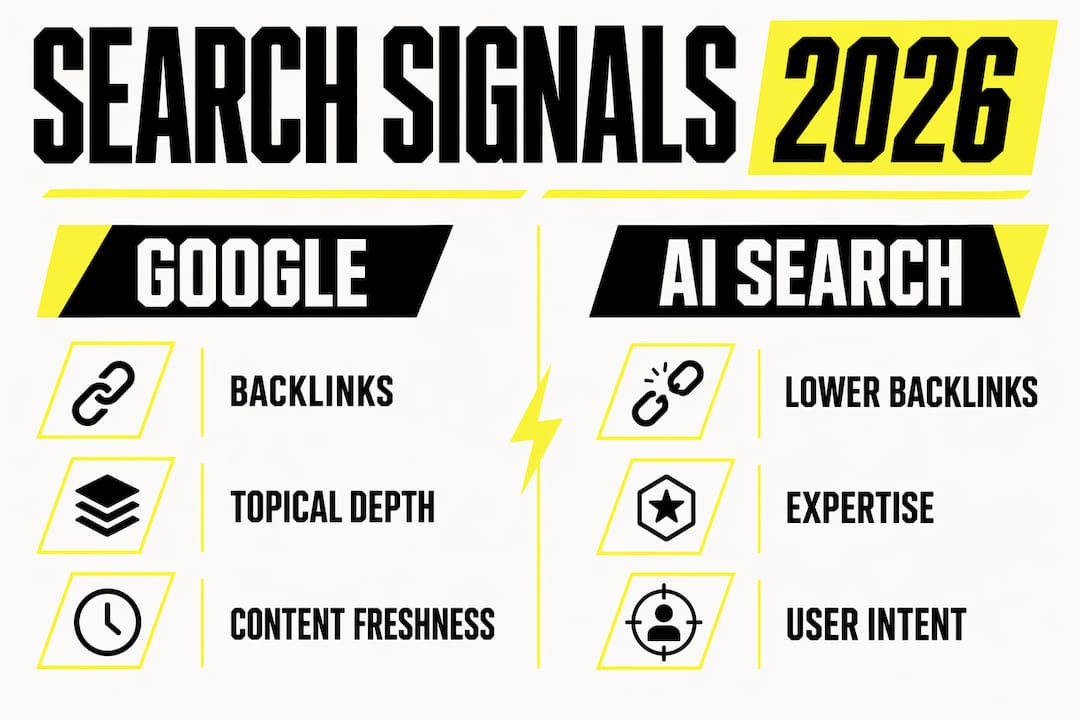
Entity authority is now the starting point for content planning, replacing a sole focus on keywords. AI engines evaluate real expertise and credible assets rather than relying on backlinks and ranking signals alone. A brand that publishes shallow content at high volume will rank for keywords but earn few LLM citations. A brand that publishes fewer, deeper pieces with named authors and original data earns both.
Measurement must reflect this split. Audit your LLM visibility monthly using consistent prompts. Track citation frequency, brand sentiment, and which topics your brand gets credited for. Audit your traditional organic performance on the same cycle. Running both audits together reveals gaps that neither audit catches alone.
Track which topics trigger your brand’s citation in ChatGPT and Perplexity
Monitor brand sentiment in LLM responses, not just citation frequency
Update high-priority content at least every 13 weeks to stay within LLM recency windows
Prioritize named authorship and original data on your most important pages
Pro Tip: Run a monthly “brand prompt audit.” Type your core topic into ChatGPT and Perplexity and note whether your brand appears, in what context, and which competitors are cited instead. That gap is your content priority list.
What practical frameworks guide building a content strategy?
The three-horizon content map is the most useful planning framework for marketing teams. It organizes your content efforts by time horizon and purpose, preventing the common mistake of measuring all content by the same metric.
Horizon 1: Capture. Short-term content designed to convert ready buyers. Measured on conversion rate, lead volume, and pipeline contribution. Examples include product comparison pages, pricing guides, and case studies.
Horizon 2: Authority. Medium-term content that builds topical credibility. Measured on organic rankings, backlinks, and share of voice. Examples include in-depth guides, original research, and expert interviews.
Horizon 3: Compounding assets. Long-term content that pays off over years. Measured on inbound links, AI citations, and brand search volume. Examples include definitive reference guides, proprietary data reports, and methodology pages.
Balancing efforts across all three horizons prevents the trap of optimizing only for short-term conversions while neglecting the authority assets that make future conversions cheaper and faster.
The six-stage workflow that supports this map is equally important. A complete content strategy framework moves through audience research, content audit, topic mapping, editorial production, distribution, and measurement in a continuous cycle. The content audit step is where most teams fail. Most teams skip the audit entirely, which leads to duplicated content and misaligned topical coverage. Audits should happen quarterly in most industries, and more often in fast-moving categories.
A content marketing plan operationalizes the strategy by connecting high-level goals to quarterly priorities. Think of the strategy as the blueprint and the plan as the construction schedule. Confusing the two is a common and costly mistake. The editorial calendar sits one level below the plan. It assigns specific pieces to specific dates, owners, and channels. None of these three documents replaces the others.
Pro Tip: Before building your topic map, run a content audit using a spreadsheet. List every published URL, its traffic, its purpose, and its horizon. You will find content to retire, merge, and update before you write a single new word.
What common challenges do marketing teams face with content strategy?
The most damaging mistake is confusing a content plan or editorial calendar with a strategy. A calendar tells you what to publish on Tuesday. A strategy tells you why that piece exists, who it serves, and what success looks like. Teams that operate only from a calendar produce content without clear purpose or prioritization.
Four challenges consistently derail content strategy development:
No governance. Without defined ownership and quality standards, brand voice fragments across teams and channels. Every new hire or contractor reinvents the rules.
Spreading themes too thin. Diluting brand focus across too many topics weakens overall authority. Brands that try to own 20 topics own none of them. Pick three to five core topics and go deep.
Measuring everything the same way. A Horizon 3 reference guide should not be judged on its first-month conversion rate. Assigning the wrong metric to the wrong content type produces false negatives and kills good content before it compounds.
Skipping the audit. Building a new strategy on top of existing content without auditing it first leads to duplicate content and wasted budget. The audit is not optional. It is the foundation.
The fix for most of these challenges is the same: slow down before you publish. Spend two weeks on governance, audience research, and a content audit before you create anything new. That investment pays back within one quarter. You can also explore how social media supports broader strategy as a distribution layer once your core framework is solid.
Pro Tip: Assign a “content owner” to each topic cluster, not just each piece. That person is responsible for the cluster’s authority, coverage gaps, and measurement. Without cluster ownership, no one sees the full picture.
Key Takeaways
A content strategy built on governance, audience intelligence, and two-surface measurement outperforms any publishing schedule that lacks those foundations.
Point | Details |
Strategy before calendar | Define goals, audience, and governance before assigning publish dates or topics. |
Two-surface auditing | Track both Google rankings and LLM citation frequency monthly to capture full discovery. |
Three-horizon planning | Assign distinct metrics to capture, authority, and compounding content to judge each fairly. |
Governance is non-negotiable | Define ownership and voice standards before publishing to prevent brand fragmentation. |
Audit first, create second | Run a content audit quarterly to eliminate duplication and identify topical gaps. |
Why the brands winning in 2026 treat strategy as a living system
We have worked with enough marketing teams at Vainnewyork to recognize a pattern. The brands that grow consistently are not the ones publishing the most. They are the ones that treat their content framework as a living system rather than a document filed and forgotten after a planning retreat.
The shift to two-surface SEO is the clearest example of why this matters. A year ago, most teams were not tracking LLM citations at all. Now, brands that ignore that surface are losing discovery share to competitors who publish less but publish with more depth, named authorship, and original data. The teams adapting fastest are the ones that already had governance in place. They updated their measurement criteria and moved on. The teams without governance are still debating who owns the update.
The other pattern we see is the authority trap. Teams build Horizon 1 content because it converts quickly and satisfies short-term reporting. Then they wonder why their brand has no organic pull, no inbound links, and no LLM presence. The three-horizon map is not a theory. It is a description of how content compounds over time when you let it. The brands that commit to Horizon 3 assets, even when those assets show no return for six months, are the ones that eventually stop paying for every click.
The discipline required is not creative. It is operational. Governance, audits, and consistent measurement are the unglamorous work that makes the creative work matter. We believe that is worth saying plainly, because most content strategy advice skips it.
— Vain.
How Vainnewyork supports your content strategy work
Building a content framework from scratch takes time, expertise, and the kind of cross-functional thinking that most in-house teams struggle to sustain alone. Vainnewyork brings together content creation, brand development, and audience growth under one creative consultancy model, so your strategy has both the architecture and the execution behind it.

Whether you are starting with a content audit, building out your content marketing strategy for the first time, or rethinking how your brand shows up across AI search surfaces, Vainnewyork’s network of collaborators brings the depth and craft your content deserves. Visit the Vainnewyork solutions page to see how we approach content strategy development for brands ready to build real authority.
FAQ
What is a content strategy?
A content strategy is a documented framework that governs what content you create, who it serves, how it is distributed, and how its performance is measured against business goals.
How is a content strategy different from a content marketing plan?
A content strategy defines the governing logic and goals. A content marketing plan operationalizes that strategy into quarterly priorities and connects it to an editorial calendar.
How do I optimize content for AI search engines?
Publish content with named authorship, original data, and topical depth. Update high-priority content at least every 13 weeks, since LLMs prioritize recency within that window.
How often should I conduct a content audit?
Content audits should happen quarterly in most industries. Fast-moving categories may require more frequent reviews to prevent duplicate content and topical drift.
What is the three-horizon content map?
The three-horizon content map organizes content by purpose: Horizon 1 captures ready buyers, Horizon 2 builds topical authority, and Horizon 3 creates compounding assets measured over years.
Recommended
Comments