Creator Economy for Brands: A 2026 Pilot Playbook


The Creator Economy is a large professional market of creators, commerce, subscriptions, and platform payouts — and the single best first move for your brand is to validate a creator-led pilot with owned-audience activation, a clear measurement plan, and FTC-compliant, 1099-safe billing. This is not an influencer trend. It is a maturing media infrastructure that drives direct revenue, subscription growth, and measurable conversions. Vainnewyork helps brands move from curiosity to a running program.
Table of Contents
What does the creator economy include today?
The creator economy is a layered system, not a single channel. At the base are creators — the digital content creators, educators, podcasters, and independent professionals who build audiences directly. Above them sits creator-led commerce: product drops, affiliate storefronts, and live shopping. Surrounding both are platforms (YouTube, TikTok, Instagram, Substack, Patreon), tooling and infrastructure (analytics, payment rails, CRM), and agencies and studios like Vainnewyork that orchestrate the whole system for brands.
A few terms worth pinning down:
UGC (user-generated content): brand-briefed content produced by creators for use in paid or owned channels, not published on the creator’s own feed.
Creator-led commerce: direct product sales driven by a creator’s recommendation, often through TikTok Shop, affiliate links, or owned storefronts.
Creator studio: a production and operations layer that treats content like a media company — editorial calendar, production crew, rights management.
What makes 2026 different is professionalization and capital. Infrastructure funding into the creator economy has grown substantially in recent years, which means the tooling brands use to source, manage, and measure creators is sharply better than it was two years ago. Goldman Sachs projects the market could approach $480B by 2027, driven by AI recommendation engines, integrated e-commerce, and monetization tools. For brand teams, that means more capable partners and less operational friction.
Why should your brand invest in creator partnerships?

The business case is concrete. Brand-creator partnership spend has grown significantly in recent years — not because brands are chasing trends, but because creator content consistently outperforms traditional display on conversion and retention metrics. Creator-led commerce is the fastest-growing component: TikTok Shop has experienced rapid growth in U.S. sales.
For brands specifically, the outcomes worth tracking are:
Lower customer acquisition cost via owned-audience activation (email lists, DMs, communities) rather than paid media alone.
Product launch velocity — creator audiences respond faster to drops than cold ad audiences.
Retention and community — subscription and membership models built around creator trust outperform generic loyalty programs.
The media and entertainment shifts driving platform consolidation make this window particularly valuable for brands willing to build creator relationships now rather than later.
How creators monetize and why each model changes your deal
Understanding how a creator earns money tells you how to structure a partnership that actually works. The seven primary revenue streams are brand deals, creator-led commerce, subscriptions and memberships, platform ad revenue, digital products, UGC licensing, and consulting. Each one changes the negotiation.
Brand deals / sponsorships: flat-fee or performance-based; the creator’s editorial independence is the asset, so separating editorial from advertising protects both parties’ trust.
Creator-led commerce: rev-share or affiliate structures work well here; align incentives by tying your fee to actual sales.
Subscriptions / memberships: the creator’s owned audience is the leverage; brands that co-sponsor a newsletter or community get direct access to a high-intent list.
UGC / licensing: fastest time-to-first-dollar, no follower minimum required, and ideal for scaling creative assets across paid channels.
Digital products and consulting: signals a highly professionalized creator — expect higher rates and clearer SOWs.
Monetization follows trust, not features. Validate demand through direct audience engagement — surveys, small launches, DM-based offers — before committing to high-fidelity production spend. Creators who have done this work are better partners because their audience is already primed to act.
Pro Tip: Ask any creator you’re considering to share a recent DM campaign or direct-link offer result. Direct delivery in DMs converts at 12–28% versus 2–5% for link-in-bio, which tells you whether their audience is genuinely engaged or just scrolling.
Which collaboration format fits your goal?
Format | Best for | Typical deliverables | Recommended KPI |
Sponsored post / integration | Awareness, reach | 1–3 posts, story set | Reach, CPM, brand recall |
Co-created content series | Engagement, community | 4–12 episodes, owned assets | Engagement rate, saves, subs |
UGC / licensed creative | Paid media scaling | 5–20 raw assets | CTR, CPA on paid channels |
Commerce / affiliate | Direct conversion | Storefront, links, live | Revenue, ROAS, AOV |
Product collaboration | Product development | Co-branded SKU, launch content | Sales volume, press coverage |
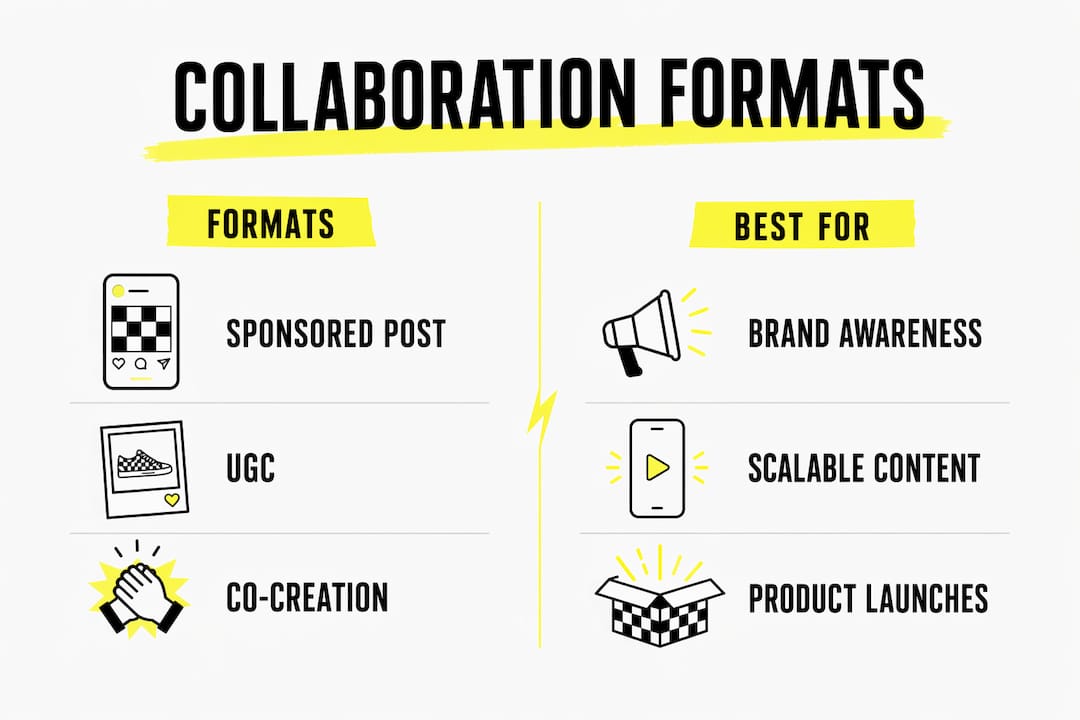
Use UGC when you need scalable creative at low cost. Use co-creation for product launches where the creator’s credibility is the proof point. Commerce partnerships work best when the creator already sells to your customer profile. Pair any of these with a social media activation plan to extend reach beyond the creator’s own feed.
How do you evaluate and select the right creators?
Start with audience fit, not follower count. A creator with 15,000 highly engaged followers in your exact demographic will outperform a mid-tier account with 200,000 passive ones. Micro-influencers show higher engagement and can charge $200–$1,500 per post, making them the most cost-efficient entry point for most pilots.
Vetting checklist:
Demographic alignment: does the creator’s audience match your buyer profile by age, location, and intent?
Engagement quality: are comments substantive, or are they emoji-only and bot-patterned?
Content style: does the creator’s visual and editorial voice align with your brand identity?
Operational readiness: can they deliver on time, invoice properly, and sign a usage-rights agreement?
1099 readiness: do they have a W-9 on file and a clear contractor billing setup?
Red flags to cut immediately: engagement spikes with no content history, undisclosed paid content patterns, follower-to-engagement ratios that don’t hold across post types, and resistance to FTC disclosure language in the brief.
Pro Tip: Review the creator’s last 90 days of content before outreach. Creators who build audiences like columnists — consistent voice, clear editorial point of view, audience interaction — are far more reliable partners than those chasing viral moments.
What does a creator partnership actually cost in the US?
Pricing varies by tier, format, and production complexity. Here is a working framework:
Pricing model | When to use | Typical shape |
Flat fee | Sponsored posts, UGC packs | Nano: $200–$1,500 / Micro: $200–$1,500 / Mid-tier: $2,000–$10,000 |
Performance / CPA | Commerce, affiliate | 5–20% of attributed sales |
Rev-share | Product collabs, subscriptions | 10–30% of co-branded revenue |
Retainer | Ongoing content programs | $1,500–$4,000/month for micro-to-mid |
Production + talent split | High-fidelity video | Talent fee + $3,000–$15,000 production |
A sample 90-day pilot budget for a mid-size brand: 3–5 micro-creators at $500–$1,500 each, UGC asset production at $2,000–$4,000, platform amplification at $3,000–$5,000, and measurement tooling at $500–$1,000. Total: roughly $10,000–$20,000 to generate real signal.
Pro Tip: Separate the talent fee from the production fee in every contract. Bundled quotes hide where costs are going and make it harder to renegotiate or repurpose assets later.
What legal basics does every brand marketer need?
This is general information, not legal advice — confirm specifics with a qualified attorney for your situation.
Contract essentials:
Usage rights: specify duration (6 months, 1 year, perpetual), territory (US only, worldwide), and channel (paid social, OOH, broadcast).
Deliverable acceptance: define revision rounds, approval timelines, and kill-fee terms.
Payment terms: net-15 or net-30, with a clear invoicing trigger.
Confidentiality and indemnity: protect your brief, your product roadmap, and your brand from unauthorized use.
FTC disclosure requirements:
Any paid relationship must be disclosed clearly and conspicuously — not buried in hashtags or below the fold.
“#ad” or “Paid partnership with [Brand]” at the top of the caption satisfies the standard for most formats.
Affiliate links require disclosure even when no flat fee changes hands.
Tax and billing:
Collect a W-9 from every creator paid $600 or more in a calendar year; issue a 1099-NEC by January 31.
Contractor classification matters: a creator briefed on deliverables but not on hours or methods is generally a contractor, not an employee — but confirm with your legal team for edge cases.
How do you measure creator campaign impact?
Core KPI categories:
Attention: views, reach, impressions, share of voice.
Engagement: engagement rate (interactions divided by reach), saves, comments with substantive content.
Conversion: link clicks, promo-code redemptions, purchases, email sign-ups.
Business lift: A/B holdout tests, incrementality studies, brand-recall surveys.
Reporting cadence:
Weekly (operational): reach, engagement rate, click volume, promo-code use. Owner: campaign manager.
Monthly (strategic): CPA, ROAS, email list growth, content repurposing performance. Owner: marketing director.
Pair creator measurement with your broader content marketing strategy to attribute creator-driven lift accurately across channels.
How do you scale from a pilot to a full program?
Scaling without losing quality requires operational infrastructure, not just more creators. Diversify revenue streams and build owned audiences — email lists, SMS, communities — before you scale spend on platform-dependent activations.
Operational checklist for scaling:
Centralize usage rights in a single asset library with expiration tracking.
Standardize SOWs and onboarding documents so new creators ramp in days, not weeks.
Automate payment via a creator payments platform (Trolley, Tipalti, or similar) to handle 1099 volume.
Build a content repurposing workflow: every creator asset should produce at least three derivative formats (cut-down, static, email embed).
Pro Tip: Treat your best creators like a production studio relationship, not a vendor list. A retainer plus a production team budget produces more consistent output than a series of one-off briefs — and the creator’s audience notices the difference in quality.
A practical 90-day pilot playbook
Weeks 1–2: Discovery
Define one hypothesis: “Creator X driving Y audience will produce Z conversions at a CPA under $W.”
Shortlist 5–8 creators using the vetting checklist above.
Confirm legal setup: W-9s collected, brief drafted with FTC language, usage rights defined.
Weeks 3–4: Creative sprint 4. Brief creators with brand guidelines, key message, and one clear call to action. 5. Review and approve content; confirm disclosure language is in place before any post goes live.
Weeks 5–10: Launch and measure 6. Publish content; activate paid amplification on top-performing organic posts within 48 hours. 7. Track weekly KPIs against your hypothesis; flag underperformers by week 7.
Weeks 11–12: Measure and iterate 8. Run a full attribution review: last-touch plus any incrementality signal available. 9. Score each creator against your go/no-go criteria (CPA, engagement quality, production reliability). 10. Brief your team on which creators to retain, which formats to scale, and where a production partner adds leverage.
Pro Tip: Involve a production or strategy partner like Vainnewyork at week 1, not week 9. The brief quality, rights structure, and measurement setup you establish at the start determine whether the pilot generates real signal or just content.
Key Takeaways
The creator economy is a $314 billion professional market heading into 2026, with Goldman Sachs projecting growth toward $480 billion by 2027.
Point | Details |
Scale justifies investment | Brand-creator spend has grown significantly in recent years and continues to rise. |
Commerce is the fastest-growing segment | TikTok Shop has experienced rapid growth in U.S. sales; commerce outpaces traditional brand deals in growth rate. |
Pilot before scaling | Run a 90-day pilot with 3–5 micro-creators, a clear hypothesis, and a $10,000–$20,000 budget to generate real signal. |
Legal basics protect everyone | Collect W-9s, define usage rights by duration and channel, and require FTC disclosure language in every brief. |
Vainnewyork as your partner | Vainnewyork provides creative production, campaign strategy, and measurement ops to take brands from pilot scoping to a running creator program. |
Vain.'s perspective on what most brands get wrong
The conventional wisdom says start with a big creator and a big budget. We think that is exactly backward. The brands that build durable creator programs almost always start small, with a tight hypothesis and a creator whose audience genuinely overlaps their buyer. The pilot is not a test of the creator. It is a test of the brand’s ability to brief, measure, and iterate.
What we see consistently is that brands underestimate the editorial dimension. A creator’s trust with their audience is the actual asset being licensed, and that trust erodes the moment the content reads like an ad rather than a genuine recommendation. The distinction between editorial and advertising is not just an FTC compliance issue — it is the creative quality standard that determines whether the campaign converts or disappears into the feed.
The brands that win in this space treat their best creators the way a publisher treats a contributing editor: with a clear brief, genuine creative latitude, and a long-term relationship that compounds over time. One-off briefs produce one-off results.
How Vainnewyork helps brands build creator programs
Vainnewyork is a creative consultancy and production company built for exactly this moment in the creator economy — when brands need more than a talent roster and less than a full agency retainer.
We scope and run creator pilots from brief to measurement, produce high-fidelity content that meets both brand standards and platform-native expectations, and build the operational infrastructure (SOWs, rights libraries, reporting cadences) that lets programs scale without losing quality. Our network of collaborators spans digital content creators, directors, editors, and strategists who have worked across product launches, retail activations, and subscription growth campaigns.
If you are ready to move from learning to running, start your pilot scoping with Vainnewyork today. We will help you define the hypothesis, select the right creators, and build the measurement plan before a single brief goes out.
Further reading and authoritative sources
These resources informed this guide and are worth bookmarking for your team:
The Creator Economy Just Crossed $314 Billion — the most current topline on market size, composition, and infrastructure funding.
Goldman Sachs: The Creator Economy Could Approach Half a Trillion Dollars by 2027 — macro projection and platform enabler analysis.
FTC Endorsement Guides — the primary source for disclosure requirements; review before every campaign brief.
Beehiiv: How to Monetize Your Content — practical monetization sequencing for creators and brand partners.
Creatorflow: 7 Revenue Streams for Creators — taxonomy of creator revenue models with conversion benchmarks.
Vainnewyork: Creator Tools for US Creators — platform and tooling recommendations for brand teams building creator operations.
Vainnewyork: Content Creation Guide for Marketers — production best practices for teams integrating creator content into broader campaigns.
Recommended
Comments