Business Development: A Complete Guide for Professionals


Business development is the strategic process of identifying, creating, and capturing long-term value through relationships, partnerships, and market opportunities — a definition the Business Development Association formalizes as the global standard for the discipline. It is not sales. It is not marketing. It sits at the intersection of strategy, relationships, and commercial creativity, and when it works well, it compounds.
The outcomes BD produces are worth naming clearly:
New market access — entering geographies, verticals, or customer segments that organic growth alone would take years to reach
Strategic partnerships — alliances that share resources, credibility, and distribution to mutual advantage
Scalable opportunity pipelines — structured deal flow that feeds sales, product, and marketing with qualified, relationship-sourced leads
Long-term revenue channels — recurring streams built on partnership agreements, licensing, channel deals, or co-marketing programs
At Vainnewyork, we work with brands and organizations at exactly this intersection — where creative production meets commercial strategy — and the patterns we see repeat across industries. The fundamentals of BD are learnable, measurable, and worth mastering.
Key Takeaways
Business development creates long-term value through relationships, partnerships, and market opportunities — and it requires governance, clear KPIs, and creative execution to convert strategy into revenue.
Point | Details |
Define BD’s mandate clearly | Separate BD from sales with distinct incentives, a named alliance owner, and a long-term time horizon. |
Run pilots before committing | Use a 3–6 month pilot with three to five defined KPIs to validate any partnership before scaling. |
Governance prevents failure | IMD research shows more than half of partnerships fail; C-level commitment, exit terms, and a named owner materially reduce that risk. |
Measure outcomes, not just activity | Track qualified opportunities sourced, pipeline influence, and ARR from partnerships — not just meetings held. |
Vainnewyork closes the execution gap | Creative production and co-marketing support from Vainnewyork helps BD initiatives move from signed agreement to market-ready outcome. |
Table of Contents
What does business development actually involve day to day?
BD practitioners spend their time across a wider range of activities than most job descriptions capture. The work is part researcher, part diplomat, part deal architect. Here is what that looks like in practice:
Market research and opportunity scanning. BD teams map adjacent markets, track competitor moves, and identify white space. The output is a prioritized list of opportunities worth pursuing — not a general awareness of trends.
Partnership sourcing. Finding, qualifying, and approaching potential partners is a core BD motion. A media company, for example, might source a distribution partner to reach a new content channel rather than building that channel from scratch.
Deal structuring. Once a partner is interested, BD owns the commercial and operational terms: revenue share, exclusivity windows, integration scope, and governance. This is where creativity and commercial discipline meet.
Pilot project design and oversight. Most BD initiatives start small. Designing a 90-day pilot with clear success criteria — and then running it — is a skill that separates effective BD practitioners from those who only write decks.
Go-to-market coordination. BD rarely executes alone. Coordinating with marketing on launch campaigns, with product on integration specs, and with sales on handoff criteria is a daily reality.
Channel and alliance management. Existing partnerships need attention. Reviewing performance, renegotiating terms, and deepening relationships with high-value partners is ongoing work, not a one-time event.
Strategic partnerships can accelerate access to new customers and markets, share resources and costs, and increase credibility — but only when goals are aligned and governance is in place from the start.
Pro Tip: Keep a living “opportunity register” — a simple spreadsheet tracking every potential partner, their status, the strategic rationale, and the next action. BD pipelines die when they live only in someone’s inbox.
Do you need a business development plan?
Not every organization needs a formal BD plan. A solo founder exploring one partnership does not need a 40-page strategy document. But when any of the following conditions apply, a structured plan pays for itself quickly:
You are entering a new market or geographic region
You are launching a new product and need distribution or co-marketing partners
Growth targets are unmet and organic channels are plateauing
You are managing more than two active partnership conversations simultaneously
Leadership needs to allocate budget across BD initiatives and compare expected returns
A lean BD plan template
A working BD plan does not need to be long. It needs to be honest and specific. Cover these elements:
Objective — one sentence: what does success look like in 12 months?
Target segments and ICP — which markets, verticals, or partner types are in scope?
Partnership types — channel, co-marketing, technology integration, joint venture, or licensing?
Pilot design — what is the smallest experiment that would validate the opportunity?
Success metrics — three to five KPIs with baseline and target values
Governance — who owns the partnership, who has sign-off authority, and how often is performance reviewed?
Preliminary budget — cash and in-kind resources committed to the first pilot phase
Timeline guidance
Early signals from a BD pilot typically emerge within 60–90 days. A full pilot cycle — enough to make a go/no-go decision — usually runs a few months depending on deal complexity. Plan validation (the point at which you commit to scaling) generally requires 6–12 months of data. Build these checkpoints into the plan from day one so decision-makers know when to expect a recommendation, not just an update.
Which business development tactics actually work?
Tactics are where BD strategy meets reality. The right tactic depends on your objective, your resources, and your tolerance for time-to-revenue. Here is a working playbook:
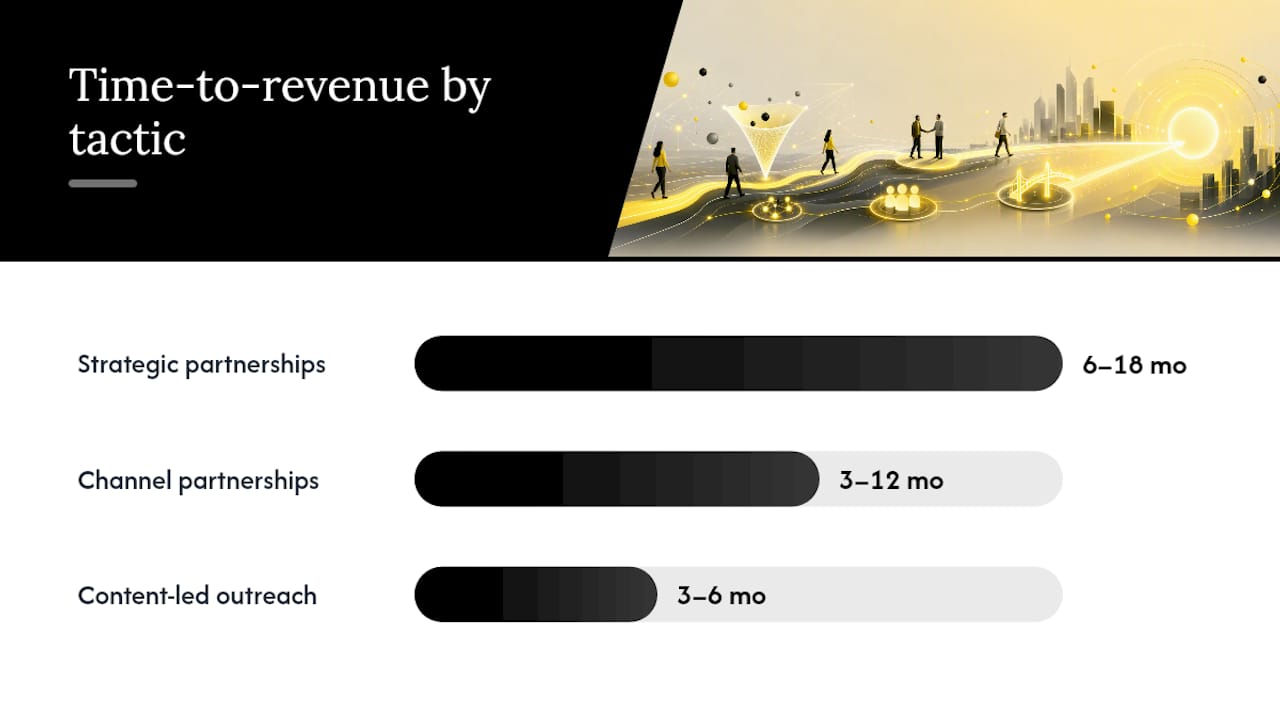
Strategic partnerships. Best for market access and credibility. Timeline: 6–18 months to meaningful revenue. Risk: governance failure and misalignment. Example: a content studio partners with a streaming platform to co-produce a series, gaining distribution it could not build alone.
Channel partnerships. Best for scaling distribution without scaling headcount. Timeline: 3–12 months. Risk: channel conflict with direct sales. Example: a SaaS company recruits resellers in markets where it lacks a local sales presence.
Content-led outreach. Best for building authority and warming cold prospects before direct outreach. Timeline: 3–6 months to pipeline influence. Risk: slow to convert without a follow-up motion. Example: a co-authored white paper with a target partner that opens the door to a commercial conversation.
SDR/BDR outreach. Best for high-volume, targeted prospecting when the ICP is well-defined. A modern SDR playbook treats prospecting as an operating system: precise ICP definition, multichannel cadences, trigger-based prioritization, and outcome metrics like conversation-to-meeting rate and qualified-opportunity rate.
Events and conferences. Best for relationship-building and deal acceleration with warm prospects. Timeline: relationship value compounds over 6–12 months. Risk: high cost per contact without disciplined follow-up.
Joint marketing programs. Best for co-branded audience growth and shared lead generation. Timeline: 2–4 months to launch. Risk: mismatched brand positioning between partners.
Product integrations. Best for technology companies seeking embedded distribution. Timeline: 6–18 months including development. Risk: technical debt and dependency on partner roadmap.
Minority investments and joint ventures. Best for deep strategic alignment where a partnership alone is insufficient. Timeline: 12–36 months. Risk: capital commitment and governance complexity.
Pro Tip: Before committing to a full partnership, run a low-cost pilot — a shared event, a co-branded content piece, or a 30-day referral test. Early signals from a small experiment are worth more than a year of negotiation without data.
Vainnewyork’s creator economy playbook offers a practical framework for one of the fastest-growing BD channels: creator and influencer partnerships, including how to structure pilots and measure early results.
How does business development differ from sales and marketing?
This is the question that causes the most organizational confusion — and the most turf conflict. The U.S. Chamber of Commerce puts it plainly: sales is tactical and transaction-oriented, while business development is long-term and relationship- or opportunity-oriented. That distinction shapes everything about how each function should be measured and managed.
Here is how the three functions compare:
Function | Primary focus | Time horizon | Typical activities | Success metrics |
Business Development | Identifying and structuring new opportunities | 6–36 months | Partnership sourcing, market entry, deal structuring, pilot design | Qualified opportunities sourced, partnerships activated, pipeline influence |
Sales | Converting opportunities into closed revenue | Days to months | Prospecting, demos, proposals, negotiation, closing | Revenue, quota attainment, win rate, deal cycle length |
Marketing | Creating awareness and demand at scale | Weeks to months | Content, campaigns, events, SEO, paid media | Leads generated, brand awareness, MQL volume, cost per lead |
The flow between them matters as much as the definitions. BD sources and structures the opportunity. Marketing creates the awareness and content that makes outreach credible. Sales converts the qualified lead into closed revenue. When these three functions operate in silos, deals fall through handoff gaps.
On governance: partnership ownership should sit with BD, not sales. Sales teams are compensated on short-term quota and will deprioritize a 12-month partnership conversation in favor of a deal closing this quarter. Assigning a named alliance owner within BD — with a separate incentive structure tied to partnership milestones — prevents that drift.
Common business development mistakes and how to avoid them
BD failures are rarely dramatic. They accumulate quietly through structural errors that compound over time.
Treating BD as tactical sales. BD managers who spend their days chasing short-term deals are not doing BD — they are doing sales without quota. Fix: define BD’s mandate explicitly in the org chart and separate its incentive structure from sales quota.
Weak governance for partnerships. A partnership without a named owner, defined KPIs, and a review cadence will drift. Fix: assign an alliance owner on day one and schedule quarterly business reviews before the partnership launches.
Unclear KPIs. “Growing the partnership” is not a KPI. Fix: define three to five measurable metrics at the pilot stage and tie them to a go/no-go decision point.
Over-investing too early. Committing significant resources before a pilot has validated the opportunity is one of the most common BD errors. Fix: use Wharton’s Window and Options framework — match your investment level to your level of certainty. A Window strategy (low commitment, high learning) is appropriate when uncertainty is high.
Ignoring integration costs. The commercial terms of a partnership often look attractive until someone calculates the operational cost of actually running it. Fix: include a cross-functional integration assessment — covering technology, legal, finance, and operations — before signing.
Pursuing too many partnerships simultaneously. A BD team managing ten active partnerships poorly will outperform a team managing twenty partnerships superficially. Fix: cap active partnerships at a number the team can genuinely govern, and use a portfolio approach to stage new bets.
How do you measure business development success?
BD is notoriously hard to measure because its outcomes often show up in other functions’ numbers. A partnership sourced by BD closes in sales and gets attributed to marketing if the partner ran a co-branded campaign. A clear attribution framework is not optional — it is what makes BD visible to leadership.
Core BD KPIs
KPI | Definition | When to use it |
Qualified opportunities sourced | Opportunities that meet ICP criteria and entered the pipeline via BD activity | Always; the primary leading indicator |
Partnership count (active) | Number of partnerships with a signed agreement and active operating model | Track at all stages; distinguish active from dormant |
Pipeline influence | Total pipeline value where BD had a documented touchpoint | Use to show BD’s contribution to sales without claiming full credit |
Deal conversion rate | Percentage of BD-sourced opportunities that close | Use after 6+ months of data; early-stage pilots need longer cycles |
ARR from partnerships | Annual recurring revenue attributable to partnership channels | Use once partnerships are generating revenue at scale |
Time-to-first-revenue | Days from partnership activation to first attributed dollar | Use for pilot evaluation and partner tier benchmarking |
Attribution guidance
Multi-touch attribution is the most honest approach for BD. A simple rule: BD gets sourcing credit when it initiated or materially advanced the relationship before a sales handoff. Marketing gets demand-generation credit for campaigns. Sales gets closing credit. Document the touchpoints in your CRM from day one — retroactive attribution arguments are unwinnable.
Reporting cadence matters. Activity metrics (meetings held, partners contacted, pilots launched) belong in weekly BD reviews. Outcome metrics (pipeline influence, ARR from partnerships, conversion rate) belong in monthly leadership reporting. Mixing the two in the same report obscures what is actually moving.
What does a Business Development Manager actually do?
The Business Development Manager role sits at the intersection of strategy, relationships, and commercial execution. According to Purdue Global’s career guide, BD professionals are responsible for identifying growth opportunities and building the relationships that make those opportunities real.
A typical week looks something like this: Monday and Tuesday involve prospecting and outreach — researching target partners, sending introductory messages, and following up on warm conversations. Wednesday centers on partner meetings and internal cross-functional syncs with product, marketing, and legal. Thursday is for deal structuring, proposal drafting, and pilot oversight. Friday is for pipeline review, CRM updates, and strategic planning.
Core skills by seniority
Research and market analysis — entry level; the ability to map a market, identify potential partners, and build a qualified target list
Relationship management — mid-level; sustaining trust with partners over time, navigating organizational complexity on both sides
Negotiation and deal structuring — mid to senior; building commercial terms that work for both parties and survive legal review
Commercial modeling — senior; projecting the financial impact of a partnership and presenting it to leadership with confidence
Internal influence — senior; getting product, legal, finance, and marketing aligned behind a BD initiative without direct authority over any of them
Storytelling and executive communication — all levels, but critical at senior; the ability to make a complex partnership opportunity legible to a CEO in three minutes
Compensation drivers
Bureau of Labor Statistics, business and financial occupations show strong employment outlook. BD compensation varies significantly by deal size, industry, geographic market, and quota structure. Technology and financial services tend to pay the highest base salaries. Variable compensation tied to partnership milestones or pipeline contribution is common at mid-to-senior levels. Geographic market matters: BD roles in New York, San Francisco, and London command meaningful premiums over equivalent roles in smaller markets.
The lifecycle of a business development initiative
Every BD initiative moves through a predictable set of stages, even when the timeline varies. Knowing where you are in the cycle helps you set realistic expectations and make better go/no-go decisions.
Discover and scan (2–6 weeks). Map the opportunity space. Identify potential partners, assess strategic fit, and prioritize the top candidates. Output: a shortlist of three to five qualified targets.
Qualify (4–8 weeks). Engage the shortlisted targets. Assess mutual interest, strategic alignment, and resource availability on both sides. Output: one or two partners willing to explore a pilot.
Pilot (a few months). Design and run a small, time-bounded experiment with clear success criteria. This is the most important stage — it is where you learn whether the opportunity is real. Output: validated (or invalidated) hypothesis with data.
Negotiate and structure (4–12 weeks). If the pilot succeeds, formalize the partnership. Define commercial terms, governance, integration scope, and exit provisions. Output: signed agreement.
Integrate and scale (6–24 months). Build the operational model that makes the partnership work at scale. This includes technology integration, team alignment, joint go-to-market execution, and ongoing performance management.
Measure and optimize (ongoing). Run quarterly business reviews, track KPIs against targets, and make deliberate decisions about deepening, adjusting, or exiting the partnership.
A note on go/no-go decisions: every stage transition should require an explicit decision, not a default continuation. Build a simple scorecard at the pilot stage — if the partnership does not hit two of three defined metrics, the default answer is no-go, not “let’s give it more time.”
Why do strategic partnerships fail — and what governance actually fixes it?
A significant proportion of strategic partnerships fail. IMD research identifies poor governance and misalignment as the leading causes — not market conditions, not product fit, not competitive pressure.
That number should reframe how you think about partnership investment. The commercial opportunity is rarely the problem. The operating model almost always is.
The root causes cluster around three themes: governance gaps (no named owner, no review cadence, no exit terms), strategic misalignment (partners pursuing different outcomes from the same agreement), and weak integration (the partnership looks good on paper but nobody built the operational bridge between the two organizations).
A governance checklist for partnerships
C-level commitment — at least one executive sponsor on each side with authority to resolve escalations
Named alliance owner — a single person accountable for the partnership’s performance, not a committee
Clear KPIs — three to five metrics agreed before launch, with baseline and target values
Defined exit terms — what triggers a review, what triggers a wind-down, and how assets are handled
Operating model — a documented description of how the two organizations will work together day to day
Shared incentives — both sides should have skin in the game; purely cash-based arrangements tend to become transactional
Pro Tip: Invest “in kind” where possible — shared technology access, seconded personnel, or co-developed assets create stronger long-term incentives than cash payments alone, per IMD’s partnership research. A partner who has contributed resources has a reason to make the relationship work.
Wharton’s strategic partnership framework recommends matching your partnering posture to your level of uncertainty: use a Window strategy (low commitment, high optionality) when you are still learning, an Options strategy (moderate commitment with a defined path to scale) when early signals are positive, and a Positioning strategy (full commitment) only when the opportunity is validated. Running a portfolio of small bets across Window and Options partnerships reduces the risk of any single failure becoming a strategic setback.
How a creative consultancy contributes to business development
We have seen, across the brands and organizations we work with at Vainnewyork, that the gap between a BD strategy and a BD outcome is almost always a creative and production gap. The strategy exists. The partner is willing. But the co-branded content series never gets made, the partner launch campaign looks generic, or the integration-ready creative kit arrives three months late and misses the launch window.

A creative consultancy contributes to BD in ways that are concrete and measurable. Audience research that maps a target partner’s community against your own reveals alignment (or the absence of it) before a single commercial conversation begins. Co-marketing campaigns built around a shared creative brief give both partners something to promote. Branded partnership launch content — a short film, a content series, a visual identity for the collaboration — signals to the market that the partnership is real and worth paying attention to.
One example of a creative deliverable that consistently supports BD outcomes: a co-branded content series developed at the pilot stage, designed to generate audience data and media coverage before either partner commits to a full commercial agreement. The series serves as both a proof of concept and a marketing asset.
Vainnewyork supports your business development goals
Vainnewyork brings creative production and strategic thinking together for brands, artists, and organizations that are ready to grow through partnerships, market entry, and audience development. Where most BD efforts stall on execution, we close the gap: from market entry content and co-marketing programs to partnership launch creative and audience growth projects, our work is built to move BD initiatives from conversation to outcome.
Whether you are launching a new partnership, entering a new market, or building the creative infrastructure for a co-branded campaign, Vainnewyork’s production and consultancy capabilities are designed to support every stage of the BD lifecycle. Our brand collaboration and merch drop playbook and digital marketing strategies are available as starting points. To discuss a project, visit Vainnewyork and send us a project inquiry — we respond to every serious conversation.
Sources
Recommended
Comments