Digital Marketing Strategies for Business Growth in 2026


Digital marketing is the deliberate use of digital channels and data-driven tactics to engage target audiences and meet defined business objectives. It covers everything from SEO and email campaigns to paid search, social media, and content production. Unlike traditional advertising, it gives you measurable feedback at every stage of the customer funnel. Business owners and marketers who treat it as a coordinated system, rather than a collection of isolated tactics, consistently outperform those who do not. This guide breaks down the channels, frameworks, metrics, and 2026 trends you need to build a strategy that actually delivers results.
What is digital marketing and why does it matter?
Digital marketing is defined as the strategic use of owned, paid, and earned digital channels to move prospects through awareness, consideration, and conversion. The distinction between digital marketing and digital advertising matters here. Advertising is one paid component within a much larger system. The full system includes SEO, content marketing, email marketing campaigns, social media, and programmatic display, all coordinated around a single customer journey.
SMART objectives anchor every effective campaign. Specific, Measurable, Achievable, Relevant, and Time-bound goals replace vague targets like “get more traffic” with concrete benchmarks like “increase organic leads by 30% in 90 days.” Without that precision, budget allocation becomes guesswork and measurement becomes meaningless.
The customer funnel gives structure to channel selection. Awareness channels build reach. Consideration channels nurture intent. Conversion channels capture demand. A coordinated media mix across all three stages produces compounding returns that no single channel can match alone.
What are the primary digital marketing channels and their roles?
Successful digital marketing is less about finding the single best channel and more about coordinating multiple channels aligned with user intent and funnel stage. Each channel type serves a distinct purpose, and mixing them correctly is what separates profitable programs from expensive experiments.
Channel | Type | Funnel role | Key KPI |
SEO | Owned | Awareness, consideration | Organic traffic, rankings |
Content marketing | Owned | Awareness, consideration | Time on page, leads |
Email marketing | Owned | Consideration, conversion | Open rate, revenue per email |
Paid search (PPC) | Paid | Conversion | CPA, ROAS |
Programmatic display | Paid | Awareness | Impressions, reach |
Retargeting | Paid | Consideration, conversion | CTR, conversion rate |
Social media | Earned/Paid | Awareness, consideration | Engagement, followers |
SEO and content marketing build long-term authority at a lower cost per acquisition over time. PPC advertising basics are straightforward: you pay per click on search ads and control spend precisely, making paid search ideal for capturing high-intent demand. Email marketing campaigns deliver the highest return on investment of any owned channel because you communicate directly with people who already opted in.
Social media marketing builds brand awareness and community, but organic reach on most platforms has declined significantly. Paid social fills that gap, particularly for retargeting audiences who visited your site but did not convert. Video content performs exceptionally well across both organic and paid social placements, driving higher engagement than static formats.
Programmatic advertising automates the buying of display inventory across thousands of sites, targeting by behavior, demographics, and context. Retargeting layers on top of that by serving ads specifically to people who already showed interest. Together, they form a demand-generation and demand-capture loop that keeps your brand present throughout the decision process.
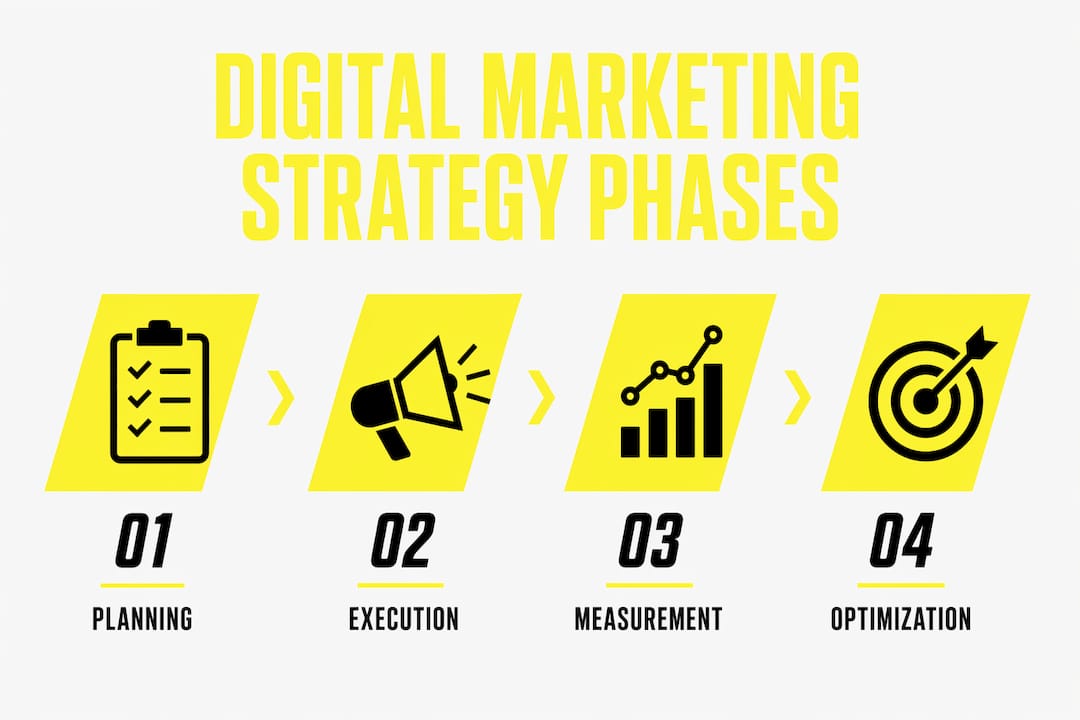
How to build a digital marketing strategy that maximizes ROI
A structured digital marketing strategy involves four key phases: Planning, Execution, Measurement, and Optimization, each crucial for aligning business goals to marketing activities. Skipping any phase breaks the chain and wastes budget.
Planning starts with persona development and SMART goal setting. You define who you are reaching, what action you want them to take, and which channels match their behavior at each funnel stage. Budget allocation follows channel selection, not the other way around.

Execution means launching campaigns with tracking fully configured before the first dollar is spent. Marketing teams waste over 25% of their digital advertising budgets without clear performance frameworks. That waste is almost always preventable with proper setup.
Measurement requires connecting your analytics stack to your CRM so you can trace revenue back to the channel that generated it. Without that connection, you are optimizing for clicks, not customers.
Optimization is where most teams underinvest. Reviewing performance weekly and adjusting bids, creative, and targeting based on real data compounds gains over time.
Define SMART goals before selecting channels
Build audience personas based on real customer data
Align channel selection to funnel stage, not preference
Configure attribution and tracking before launch
Review performance weekly and adjust in real time
Pro Tip: Run a 90-day roadmap with 3–5 clear priorities instead of an annual plan. Markets shift fast, and quarterly cycles let you reallocate budget toward what is working without waiting for a year-end review.
Matching advertising formats to user intent and synchronizing demand-capture with demand-generation channels is the core of a profitable media mix. Paid search captures people ready to buy. Display and social build the awareness that makes paid search more effective. Running them in isolation produces weaker results than running them together.
What are the essential metrics for measuring digital marketing success?
Effective metrics vary by funnel stage: impressions and reach for awareness, engagement and sign-ups for consideration, and CPA and ROAS for conversion. Using conversion metrics to evaluate an awareness campaign is a category error that leads to cutting channels that are actually working.
The five metric categories every marketer needs to track are:
Visibility: Impressions, reach, share of voice
Engagement: Click-through rate, time on page, video views
Lead generation: Form fills, sign-ups, cost per lead
Pipeline: Qualified leads, opportunities created
Revenue: CPA, ROAS, customer lifetime value
Multi-touch attribution is necessary to properly credit each channel’s contribution. Last-click attribution, which gives full credit to the final touchpoint before conversion, systematically undervalues awareness and consideration channels. Cross-channel attribution tools like Google Analytics 4 and platforms like Northbeam provide clearer visibility across diverse touchpoints. Without proper attribution, you risk cutting channels that silently drive conversions.
Connecting marketing data to your CRM is the step most teams delay and then regret. When you can see that a specific email campaign generated 12 closed deals worth $84,000, you can defend and grow that budget with confidence. When you can only see open rates, you are flying partially blind.
Pro Tip: Pick one “north star” metric per campaign and limit your dashboard to 5–7 KPIs total. More metrics create noise, not clarity, and slow down the decisions that actually move results.
Data maturity differentiates successful marketing teams. Pre-configured analytics, attribution models, and optimization routines set up before launch are what separate teams that improve every quarter from those that repeat the same mistakes.
What are the biggest digital marketing trends shaping 2026?
AI-driven personalization and automation orchestration are the defining forces of 2026 digital marketing. AI improves campaign efficiency and customer engagement across channels, but the teams winning with it are those who pair automation with authentic human storytelling. Automation handles scale. Humans handle meaning.
The shift from volume to precision is the most important strategic change of this cycle. Brands that published 30 blog posts a month are now publishing 8 with deeper research, stronger SEO, and genuine utility. That shift reflects a broader move toward value-driven content marketing over content for content’s sake.
Privacy compliance has moved from legal checkbox to brand differentiator. Privacy laws and ethical marketing practices contribute to trust, compliance, and longer-term customer loyalty. Brands that handle data transparently and respect customer rights build audiences that are harder for competitors to poach.
Creator partnerships are maturing. One-off influencer deals are giving way to long-term collaborations where creators become genuine brand voices. That depth produces more credible content and stronger audience trust than a single sponsored post ever could. Social media marketing strategies built around sustained creator relationships outperform transactional campaigns in both engagement and conversion.
“Marketers who integrate AI-driven analytics with human creativity and ethical transparency gain a sustainable competitive edge in 2026. Technology sets the floor. Creativity and trust set the ceiling.”
Predictive retention programs are also gaining traction. Instead of spending exclusively on acquisition, brands are using behavioral data to identify customers at risk of churning and intervening before they leave. Retaining an existing customer costs a fraction of acquiring a new one, and predictive models make that intervention precise rather than reactive.
Key takeaways
Effective digital marketing requires coordinated channel use, precise measurement, and continuous optimization aligned to funnel stage and business objectives.
Point | Details |
Coordinate channels by funnel stage | Match awareness, consideration, and conversion channels to user intent for compounding returns. |
Configure tracking before launch | Set up attribution and analytics before spending a dollar to avoid wasting over 25% of ad budget. |
Use multi-touch attribution | Last-click models undervalue awareness channels; use tools like Google Analytics 4 for full visibility. |
Run 90-day roadmaps | Quarterly planning cycles let you reallocate budget toward what is working faster than annual plans. |
Pair AI with human creativity | Automation handles scale, but authentic storytelling and ethical data use build lasting audience trust. |
What we have learned from building real campaigns
The biggest mistake I see business owners make is treating digital marketing as a channel problem when it is actually a measurement problem. They add a new platform, see unclear results, and move on to the next one. The real issue is that they never set up attribution properly, so they cannot tell which channels are working and which are not.
The second pattern I notice is channel sprawl. Teams spread thin across six platforms produce mediocre results on all of them. Focusing on two or three channels and executing them with real depth almost always outperforms a scattered presence. Funnel alignment is the discipline that forces that focus. When you ask “what stage is this channel serving?” you naturally eliminate the channels that do not fit.
AI tools are genuinely useful for scaling content production and personalizing outreach, but they require human judgment at every decision point. The brands I respect most use AI to do more of what they are already good at, not to replace the creative thinking that made them good in the first place. Ethical data use is not just a compliance issue. It is a trust issue, and trust is the asset that compounds over time.
— Vain.
How Vainnewyork supports your marketing goals
Vainnewyork is a creative media and technology company built around the belief that great marketing starts with great content and clear strategy. We work with business owners and marketers to develop content, build brand presence, and grow audiences through coordinated creative production.
Whether you are building a content program from scratch or refining an existing campaign, Vainnewyork brings together strategy, production, and creative direction under one roof. Our collaborator network means you get the right expertise for each project without the overhead of a full agency retainer. Browse the Vainnewyork shop to see how we bring brand and culture together, and reach out to discuss how we can support your next campaign.
FAQ
What is digital marketing in simple terms?
Digital marketing is the use of online channels, including search, social media, email, and paid ads, to reach target audiences and drive specific business outcomes like leads or sales.
How do I start digital marketing for my business?
Start by defining SMART goals, identifying your audience, and selecting two or three channels that match where your customers spend time. Configure tracking before you launch any campaign.
What is the difference between SEO and PPC advertising?
SEO builds organic search visibility over time at no cost per click, while PPC advertising delivers immediate placement in search results at a cost per click. Both serve different funnel stages and work best together.
How do I measure digital marketing ROI?
Connect your analytics platform to your CRM and track revenue back to the channel that generated it. Use multi-touch attribution models rather than last-click to get an accurate picture of each channel’s contribution.
What digital marketing trends matter most in 2026?
AI-driven personalization, privacy-first data practices, precision content over volume, and long-term creator partnerships are the four trends with the most measurable impact on campaign performance in 2026.
Recommended
Comments