Building an Audience That Pays Attention and Converts


The fastest path to growing a following starts with three decisions you can make today: pick one specific audience, choose one primary medium, and publish your first piece of content before the week ends with an email capture in place. Everything else, the tools, the tactics, the monetization, builds on that foundation. Without it, you are optimizing a house that has not been built yet.
Here are your three checkable next steps for this week:
Choose your niche and write your one-sentence value proposition using this template: “I help [specific person] achieve [specific outcome] through [specific format or approach].” Example: “I help independent fitness coaches attract their first 500 clients through short-form video and a weekly email.”
Pick one platform and one repeatable format you can produce without a production crew. Short video, a newsletter, a weekly thread — choose the one that matches how you naturally communicate.
Publish your first piece and collect your first 10 email subscribers before Friday. Use a free tool like Beehiiv, ConvertKit, or Mailchimp to set up a landing page. A handful of real subscribers who opted in are worth more than many passive followers on a rented platform.
These three steps produce the highest return on early time investment because they force specificity, create a publishing habit, and begin building an asset you own. Platform followers are rented attention; an email list is the durable foundation everything else sits on.
Table of Contents
How do you define who you serve and what you stand for?
The single most common reason early creators stall is not a lack of content ideas. It is a lack of a clear positioning statement. When you cannot articulate in one sentence who you help and why they should care, neither can your audience.
Use this value-prop template to lock in your positioning before you publish a second piece of content:
“I help [specific person] achieve [specific outcome] through [specific format or approach].”
Three examples across different creator goals:
Audience for product: “I help Shopify store owners reduce cart abandonment through weekly email teardowns and conversion checklists.”
Audience for jobs/career: “I help mid-career engineers land senior roles at tech companies through resume audits and LinkedIn content.”
Audience for education: “I help first-generation college students navigate financial aid through plain-language video explainers.”
Notice how each one names a person, a problem, and a delivery mechanism. Vague positioning (“I create content about marketing”) gives the algorithm nothing to work with and gives a potential follower no reason to subscribe over the hundreds of other marketing voices.
Three questions to validate your niche before you commit
Before you publish consistently in a niche, run it through this checklist:
Is the audience specific enough to find? Can you name three communities, subreddits, LinkedIn groups, or newsletters where this exact person already gathers? If not, the niche may be too abstract.
Is the problem urgent or recurring? A problem someone faces once (buying a first home) is harder to build a recurring content habit around than a problem they face weekly (managing a remote team, growing a service business).
Can you produce 50 pieces of content on this topic without running dry? Write 10 content ideas right now. If you struggle past five, the niche may be too narrow or too far from your genuine knowledge.
Treating audience building as an act of service rather than self-promotion is what makes positioning sustainable. When your value proposition is framed around the reader’s outcome, content ideas become obvious and the audience grows because you are genuinely useful.
Pro Tip: Micro-niches feel scary because they seem small. They are not. A newsletter for “independent bookstore owners in the U.S.” sounds tiny until you realize that audience has money, a specific problem, and almost no one speaking directly to them. High-intent, underserved segments convert faster than broad audiences.
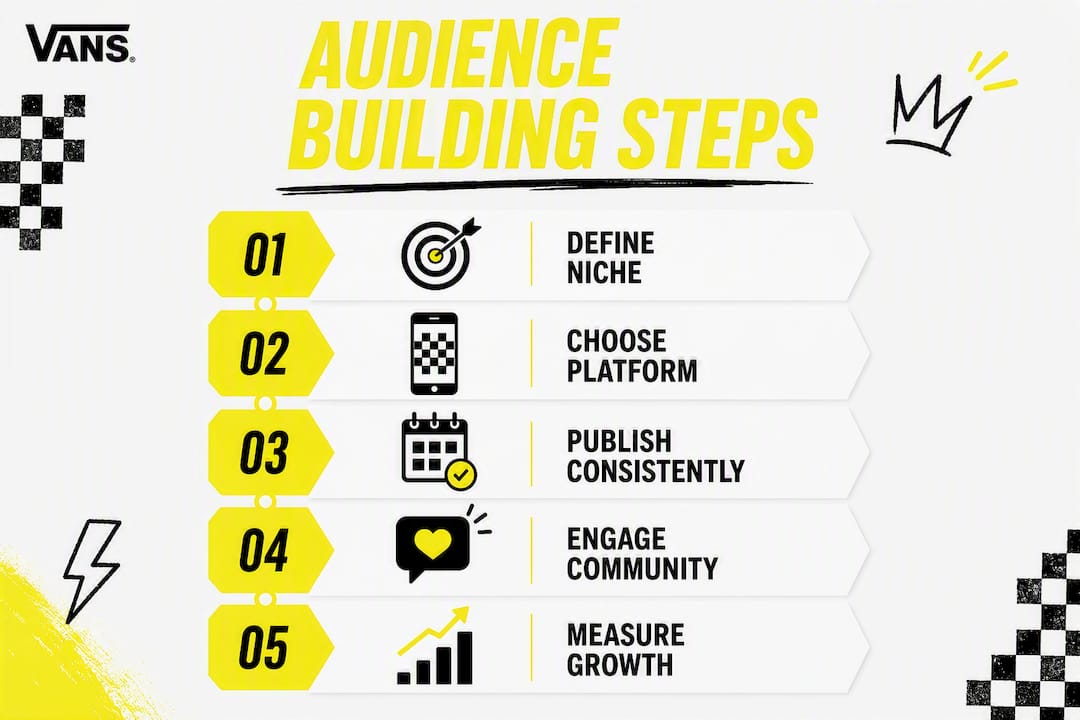
Which platform and format can you actually sustain?
Choosing the wrong platform is one of the most expensive mistakes a new creator makes, not in dollars but in months. The right medium is the one where your audience already spends time AND where you can produce content without a full production team.
Work through this decision checklist before committing:
Where does your audience already gather? LinkedIn for B2B founders, TikTok and Instagram Reels for consumer lifestyle, YouTube for tutorials, newsletters for knowledge workers. Start where they are, not where you wish they were.
What format matches your natural communication style? Writers should start with newsletters or threads. Talkers should start with video or podcasts. Forcing yourself into a format you hate produces inconsistent output.
What is the production cost in time? A polished YouTube video can take 6–10 hours per episode. A 600-word newsletter can take 90 minutes. Early on, lower production cost usually wins.
How discoverable is the platform? SEO-indexed platforms (YouTube, Google, Pinterest) compound over time. Social feeds (Twitter/X, LinkedIn) decay fast but can spike early. Both have value at different stages.
Owned vs. rented channel? Social platforms are rented. An email list is owned. The 3-3-3 rule offers a useful focus: three content types, three distribution channels, three goals per piece. Apply it by choosing one primary platform, one secondary repurposing outlet, and one owned channel (email) from day one.
Three repeatable format templates
Short-form explainer (social-first): One insight, one example, one takeaway. Works on LinkedIn posts, Instagram carousels, and Twitter/X threads. Brief: 150–300 words or 5–8 slides. Goal: reach and discovery.
Serialized newsletter: A recurring theme published on a fixed day each week. Brief: 400–800 words, one main idea, one resource, one question for the reader. Goal: habit formation and list growth.
Tutorial video: A specific how-to tied to a search query. Brief: 5–12 minutes, scripted intro hook, step-by-step middle, CTA at the end. Goal: SEO-driven discovery and subscriber conversion.
Pick one primary format. Repurpose into a second. Do not attempt three formats simultaneously in month one.
How do you publish consistently without burning out?
Consistency matters more than perfection early on. Frequent 70%-quality outputs beat infrequent polished ones for growth and skill development. The algorithm rewards regularity; more importantly, your own craft improves faster when you publish often.

Recommended minimum cadence for starters: Daily short-form content (posts, threads, short videos under 90 seconds) OR one long-form piece per week (newsletter, blog post, YouTube video). Not both, not yet.
The 5-3-2 content balance
The 5-3-2 rule gives you a practical content mix for social channels: out of every 10 posts, publish 5 curated pieces (sharing others’ insights with your commentary), 3 original informative pieces (your own expertise), and 2 personal or lightly promotional pieces. This ratio keeps your feed from feeling like a sales channel while still building authority and occasionally mentioning what you offer.
Apply it across your social presence and newsletter together. If you publish five times a week on LinkedIn and send one newsletter, the newsletter can be one of your three original informative pieces for that week.
Production checklist and batching workflow
Batching is the single most effective production shortcut for solo creators. Set aside one half-day per week to create all your content for the following week. During that session:
Write all social posts first (fastest, lowest cognitive load).
Draft the newsletter or long-form piece second.
Record video or audio last, when your ideas are already organized from writing.
Schedule everything using a tool like Buffer, Later, or Beehiiv’s scheduling feature.
A single core idea can generate multiple pieces: a newsletter section becomes a LinkedIn post, a LinkedIn post becomes a short video script, a short video script becomes a YouTube Short, and the YouTube Short description becomes an SEO-indexed blog snippet. One idea, five touchpoints. That is the content creation workflow that keeps output high without multiplying your workload.
How do you reach new people and move them into your email list?
Discovery without retention is a leaky bucket. The goal of every distribution tactic is to move a new reader or viewer into an owned channel, specifically your email list, where you control the relationship.

High-leverage outreach tactics
Guest posts and newsletter swaps are the fastest way to reach a warm, pre-qualified audience. Find three creators in adjacent niches (not direct competitors) with audiences of 1,000–10,000 subscribers and propose a content swap: you write a guest piece for their list, they write one for yours. Here is a short outreach template:
Keep it short, specific, and generous. Offer to go first.
SEO for discoverability: For long-form content and video, use free tools like Google Search Console, Ubersuggest, or YouTube’s autocomplete to find search queries your audience is already typing. Build your titles around those queries. A tutorial titled “How to Write a Cold Email That Gets Replies” will compound in search traffic for years; “My Thoughts on Cold Email” will not.
Repurposing checklist: Map one core asset to five formats:
Long-form blog post or newsletter → LinkedIn article summary
LinkedIn article → three individual social posts (one insight each)
Social posts → short video scripts
Short videos → YouTube Shorts or Instagram Reels
Video transcript → SEO-optimized blog post
Email-first conversion flow
Place your email opt-in in three locations: at the top of every long-form page (above the fold), at the end of every piece of content (post-value ask), and in your social bio link. Offer a specific incentive tied to your value proposition, a checklist, a short guide, a template, not a generic “subscribe for updates.” Welcome new subscribers within 24 hours with a three-email sequence (covered in the templates section below).
Pro Tip: The lowest-effort collaboration with the highest early return is a simple “share for share” with one creator whose audience overlaps yours. No content creation required. One post each, mentioning the other. Done in 20 minutes, and it can double your weekly subscriber intake.
How do you turn passive viewers into an active community?
Passive consumption builds reach. Active participation builds loyalty. The difference between a creator with 5,000 followers who earns nothing and one with 1,000 followers who earns consistently is almost always community depth, not audience size.
Designing content for participation rather than passive consumption is the mechanism. Small, low-friction actions scale affinity faster than polished broadcasts. A poll, a fill-in-the-blank prompt, or a “reply with your answer” CTA invites the audience into the conversation rather than positioning them as spectators.
Three CTAs and when to use each
“Reply to this” (email newsletters): Ask one specific question at the end of every newsletter. “What’s the biggest obstacle stopping you from [topic]?” Replies signal to email providers that your list is engaged, which improves deliverability.
“Join the thread” (social): Post a question or a controversial take and explicitly invite comments. “Drop your answer below” outperforms no CTA by a wide margin.
“Sign up for early feedback” (product or course launches): Ask your most engaged readers to join a beta group or feedback panel. This converts readers into collaborators and gives you product validation simultaneously.
Audience engagement deepens when you treat it as a two-way dialogue, actively soliciting and responding to questions. Batch your replies: set aside 20 minutes each morning to respond to comments and emails from the previous day. Community spotlights, where you feature a reader’s question or win in your newsletter, create social proof and reward participation.
Pro Tip: Build one small, central community space early, a free Discord server, a Circle community, or even a dedicated email group. Keep it focused on one topic. A tight, active community of 50 people is more valuable for early monetization than a passive following of 5,000.
What should you measure, and when should you monetize?
Vanity metrics (raw follower counts, total impressions) feel good and tell you almost nothing about whether your audience is ready to buy. Track the signals that predict retention and conversion: replies, saves, click-throughs, repeat visits, and open rates.
Metric | What it measures | Healthy early benchmark | Next action if low |
Email open rate | List quality and subject line strength | Healthy early benchmarks vary; focus on improving subject lines and segmentation. | |
Click-through rate (CTR) | Content relevance and CTA clarity | Early benchmarks vary; focus on improving CTAs and content relevance. | |
Engagement rate | Community depth and content resonance | Early benchmarks vary; add participation prompts and experiment with formats. | |
Subscriber growth rate | Discovery and conversion effectiveness | Growth rates vary; enhance opt-in incentives and outreach efforts. | |
Reply/comment rate | Two-way dialogue health | Typical rates vary; encourage direct questions and highlight reader responses. | |
Conversion rate | Monetization readiness | Varies widely; test low-priced offers with engaged audience segments first. |
When to test monetization
You are ready to test a paid offer when: your email list has at least 200–500 engaged subscribers (not just signups), your open rate is consistently above 30%, and you are receiving unsolicited questions about how to work with you or buy something from you. Those three signals together indicate a warm audience.
Early pricing approaches worth testing:
One-off digital product ($27–$97): a template pack, a checklist bundle, or a short course. Low friction, no ongoing commitment, and easy to validate in a week.
Low-priced group or cohort ($97–$297): a four-week live workshop or accountability group. Higher touch, stronger community signal.
Paid newsletter tier ($5–$15/month): works best when your free newsletter already has strong open rates and a loyal core.
For a deeper look at turning audience into revenue, the monetizing content playbook covers offer structures and pricing frameworks in detail.
How do you identify winners and scale what works?
Not every piece of content deserves more of your time. The goal is to find the formats and topics that consistently outperform your average, then produce more of those and less of everything else.
Winner-signals checklist:
Engagement rate is at least 50% above your average for that platform
The post or email generated unsolicited replies, shares, or saves without a direct ask
Multiple people referenced the piece in later conversations or DMs
The content drove a measurable spike in email signups or profile visits
You received requests to expand on the topic
Simple A/B test plan
Hypothesis: “A subject line with a specific number will outperform a question-style subject line for my list.”
Metric: Email open rate
Sample size: Send to two equal segments of at least 200 subscribers each
Decision rule: If the winning variant outperforms by more than 5 percentage points across two consecutive sends, adopt it as the default
When to quit a format: If a content format produces below-average engagement for eight consecutive pieces and you have tested at least two variations of the hook or structure, retire it. Eight data points is enough signal. Do not let sunk cost keep you publishing content that your audience is quietly ignoring.
Once a winner is identified, build a scaling playbook: repurpose the winning piece into every secondary format in your repurposing map, consider a small paid amplification budget ($50–$200 to boost the post or promote the email opt-in), and create two to three follow-up pieces that go deeper on the same topic.
Your ready-to-run 30-day launch plan
This week-by-week roadmap gives you a concrete daily structure for your first month. The principle behind it: publish daily for the first 30 days to build the habit, gather data, and find your voice before optimizing anything.
Week 1: Foundation (Days 1–7)
Day 1: Write your value proposition. Set up your email capture page (Beehiiv, ConvertKit, or Mailchimp). Write your first welcome email.
Day 2: Publish your first piece of content on your chosen platform. Share it in two communities where your audience gathers.
Days 3–5: Publish one short-form piece each day. Respond to every comment and reply personally.
Day 6: Reach out to two creators for a content swap using the outreach template above.
Day 7: Review your first week. Note which piece got the most engagement. Write 10 content ideas for week two.
Daily micro-task checklist: Publish (20–30 min) → Engage/reply (15–20 min) → Repurpose one piece (10–15 min) → Log one metric (5 min). Total: roughly 50–70 minutes per day.
Week 2: Content and outreach (Days 8–14)
Publish daily short-form content. Send your first newsletter.
Follow up on your two outreach messages. Send two more.
Add a content upgrade or lead magnet to your most-viewed piece.
Checkpoint: Did you gain at least 10 new email subscribers? If not, add an opt-in CTA to every piece of content you published.
Week 3: Community and engagement (Days 15–21)
Add one participation prompt to every post (poll, question, fill-in-the-blank).
Feature one reader reply or question in your newsletter.
Publish one longer-form piece (tutorial, deep-dive, or case study) optimized for search.
Checkpoint: Is your email open rate above 30%? If not, test a new subject line format.
Week 4: Measure and double down (Days 22–30)
Identify your top two performing pieces. Create follow-up content on those topics.
Send a short survey to your email list (three questions maximum) asking what they want more of.
Test one monetization signal: mention a future product, workshop, or service and note who clicks or replies.
Checkpoint: Review all four weeks. Which format, topic, and platform drove the most subscriber growth? That is your primary focus for month two.
Pro Tip: Protect your energy in week one by setting a hard stop on content production time. Fifty focused minutes beats three scattered hours. Burnout in week two is the most common reason new creators quit before they have enough data to make good decisions.
What does audience growth actually cost in time and money?
Honest expectations matter. Most creators underestimate the time required and overestimate how quickly follower counts translate into income.
Milestone | Organic-only timeline | With light paid support | Notes |
First 100 social followers | 2–6 weeks | 1–3 weeks | Depends heavily on posting frequency and niche |
First 100 email subscribers | 4–10 weeks | 2–5 weeks | Faster with a lead magnet and content swaps |
First 1,000 email subscribers | 6–18 months | 3 months | Compounding effect kicks in after month three |
First $1,000 in revenue | 3–12 months | 2–6 months | Requires a warm list and a tested offer |
Sustainable part-time income | 12–24 months | 8–18 months | Depends on niche, offer, and consistency |
Cost brackets
DIY (under $50/month): Free tiers of Beehiiv or ConvertKit for email, Canva for graphics, Buffer for scheduling, Google Analytics for tracking. This is the right starting point for most creators.
Part-time help ($300–$1,500/month): A freelance video editor ($25–$75/hour), a part-time social media assistant, or a copywriter for newsletters. Hire editing first — it saves the most time per dollar.
Full-service ($2,500–$8,000+/month): A creative consultancy handling strategy, production, and distribution. Worth it when you have a proven offer and need to scale output without scaling your own hours.
Outsourcing priority order: Edit first, then paid ads, then community management. Editing multiplies your output immediately. Paid ads only make sense once you have a converting opt-in page and a tested offer. Community management scales only after you have a community worth managing.
For context on how media trends are shaping audience growth timelines, the media and entertainment industry trends breakdown offers useful framing for where attention is moving.
Copy-ready templates, hooks, and a 3-email welcome sequence
Five high-converting hook templates
The specific number: “3 things I wish I knew before building my first email list from zero.”
The counterintuitive claim: “Posting more often actually hurt my growth. Here’s what I did instead.”
The direct question: “What’s stopping you from charging more for your work?”
The before/after: “Six months ago I had 47 subscribers. Here’s the one change that moved the needle.”
The named mistake: “The biggest mistake new creators make with their first newsletter (and how to fix it in 10 minutes).”
Use these for social post openers, email subject lines, and video titles interchangeably.
Repurposing map: one asset, five formats
Start with a 1,000-word newsletter or blog post. From that single asset:
LinkedIn post: Pull the single strongest insight. 150–200 words, no link in the post body.
Twitter/X thread: Break the post into 5–7 numbered tweets, one idea per tweet.
Short video script: Use the intro hook and the top three points. Record a 60–90 second video.
YouTube Short or Reel: Cut the strongest 30 seconds of the video.
SEO blog post: Expand the newsletter into a 1,500-word post with keyword-optimized title and headers.
Three-email welcome sequence
Email 1 — Welcome (send immediately on signup):
Subject: “You’re in. Here’s what to expect.” Body: Thank them for subscribing. Deliver the lead magnet if you offered one. Tell them exactly what you send, how often, and why it matters to them. One sentence: what is the single most useful thing they will get from being on your list?
Email 2 — Value-add (send 2–3 days later):
Subject: “The [topic] mistake most people make (and how to avoid it)” Body: Share your single best piece of advice or a short tutorial. No pitch. Pure value. End with a question: “What’s your biggest challenge with [topic] right now?”
Email 3 — Soft ask (send 5–7 days later):
Subject: “Quick question for you” Body: Reference the question from Email 2. Share one or two replies you received (with permission). Then mention what you offer: “If you want help with [specific outcome], here’s how I can help: [link].” Keep it one sentence. No pressure.
CTA variants for different goals
For comments: “Drop your answer below. I read every reply.”
For shares: “If this was useful, forward it to one person who needs it.”
For email signups: “Want the full checklist? [Get it here] — it takes 30 seconds to grab.”
Key Takeaways
Building an audience that converts requires owning the channel, publishing consistently before optimizing, and treating every piece of content as an invitation to participate rather than a broadcast.
Point | Details |
Start with email from day one | Platform followers are rented; an email list is the owned asset that enables sustainable monetization. |
Publish at 70% quality, consistently | Frequent output beats infrequent perfection for early growth and skill development. |
Use the 5-3-2 content balance | Out of every 10 posts: 5 curated, 3 original informative, 2 personal or promotional. |
Measure engagement, not vanity metrics | Track open rates, replies, saves, and CTR — the signals that predict retention and conversion. |
Vainnewyork for full-service support | For creators and founders who want expert strategy and production behind their audience growth, Vainnewyork offers creative consultancy and content production packages. |
What we’ve learned building audiences for clients
The most consistent lesson from working with creators and founders on audience growth is this: the people who build durable audiences are not the ones with the best content. They are the ones who committed to a specific person, a specific problem, and a specific format long enough to let compounding do its work.
Three practical lessons we return to with every client:
Prioritize owned channels from the start. We have seen creators build audiences of tens of thousands on a single platform, only to watch their reach collapse after an algorithm change. The ones who weathered those shifts had email lists. The ones who did not had to start over. This is not a hypothetical risk; it is a pattern that repeats.
Test offers earlier than feels comfortable. Most creators wait too long to monetize because they fear their audience is not ready. In practice, a warm list of 300 engaged subscribers will tell you more about your offer’s viability in one week than 18 months of free content will. The feedback from a $47 product launch, even a failed one, is irreplaceable.
Document the journey as content. The process of building an audience is itself compelling content for an audience that wants to do the same thing. Sharing what you are learning, what is working, and what is not creates authenticity and generates content ideas simultaneously. It is one of the most underused strategies we see.
Kevin Kelly’s 1,000 True Fans framework remains one of the most clarifying ideas in this space: you do not need a massive audience to build a sustainable creative business. You need a small number of people who genuinely care about what you do. Everything in this playbook is designed to help you find and serve those people.
How Vainnewyork supports your audience growth
Growing a following from scratch is one of the most rewarding things a creator or founder can do, and one of the most time-consuming. Vainnewyork offers creative production and strategy packages built specifically for that challenge: from defining your positioning and content format to producing video, audio, and written content at a cadence your audience will notice.
A typical engagement starts with a discovery call where we map your current position, your audience goal, and the gap between them. From there, we scope a production and strategy plan with a clear timeline, usually four to twelve weeks depending on the depth of work. You get a team of collaborators handling the craft while you focus on the relationships and the ideas.
If you are ready to move faster than the DIY path allows, reach out to Vainnewyork to start the conversation. A 30-minute discovery call costs nothing and leaves you with a clearer picture of what your audience growth could look like with the right production and strategy behind it.
Useful sources and further reading
The resources below are worth bookmarking as you move through your first 30 days and beyond:
The Audience Shortcut — Nathan Barry: — A practitioner’s argument for building an audience through service rather than self-promotion. Directly applicable to your value-prop work.
5 proven strategies to deepen audience engagement — INMA: — Habit formation, recurring series, and two-way dialogue tactics backed by newsroom-level research.
Content creation workflows — Vainnewyork: Practical production workflows and batching techniques for solo creators and small teams.
Social media marketing strategies — Vainnewyork: Platform-specific distribution tactics and best practices for growing a following across channels.
Monetizing content — Vainnewyork: A revenue-first playbook covering offer structures, pricing frameworks, and conversion tactics for creators ready to monetize.
WordPress.org: The standard open-source platform for building an owned website and blog, giving you full control over your long-form content and SEO presence.
Recommended
Comments