7 Layered Audience Segmentation Examples for Marketers That Drive Lift


Audience segmentation is the practice of dividing a market into distinct groups based on shared traits so messaging, offers, and channels can match each group’s actual needs. The most actionable types are demographic, geographic, behavioral, psychographic, technographic, lifecycle, and firmographic segmentation. Marketers who combine two or three of these instead of relying on one see sharper targeting, stronger conversion rates, and better retention over time.
TL;DR:
Combining two to three segmentation types improves targeting, conversion, and retention more than relying on a single approach.
Behavioral and psychographic segmentation are particularly effective when message tone or customer values need to influence campaigns.
Building segments should start with specific decisions or offers, using minimum audience sizes and clear inclusion rules for reliable results.
Segment performance must be measured through conversion lift, retention, revenue, and cost, with caution against over-segmentation or demographic-only targeting.
AI and psychographic segmentation work best when audiences are demographically similar but differ in behavior or motivation, with pilot testing essential before scaling.
Table of Contents
Audience Segmentation Examples by Type
Every segmentation type answers a different marketing question. Picking the wrong one, or stopping at just one, is why so many campaigns feel accurate on paper and flat in practice.
Demographic segmentation answers “who are they?” It groups people by age, gender, income, education, or family status. A skincare brand targeting women 35 to 50 with anti-aging serums, while running a separate campaign for teens with acne treatments, is demographic segmentation at its most basic. It remains the most widely used method because the data is cheap and easy to collect, though Acxiom’s research on market segmentation notes that demographic-only targeting tends to produce shallower insight than approaches that layer in behavior and psychology.
Geographic segmentation answers “where are they?” A pizza chain pushing a lunch discount only to app users within three miles of a store, or a SaaS company scheduling email sends by local time zone instead of one blanket send time, both use location as the deciding filter.
Behavioral segmentation answers “what do they do?” This is where marketing gets tactical fast. A retailer that separates frequent buyers, one-time purchasers, and cart abandoners, then builds a distinct win-back flow for each, is running textbook behavioral segmentation. Monday documents an e-commerce retailer that improved retention specifically by treating those three behavioral groups differently instead of emailing everyone the same discount.
Psychographic segmentation answers “why do they decide?” It groups people by values, lifestyle, and attitude rather than age or location. A clothing brand that builds one campaign around sustainability for environmentally minded shoppers and a completely different campaign emphasizing style and status for image driven shoppers is segmenting psychographically. These attributes, including lifestyle, interests, and personality traits, are usually gathered through surveys, content engagement patterns, or inferred modeling, according to Indeed’s overview of demographics versus psychographics.
Technographic segmentation answers “what tools or devices do they use?” A B2B software company that builds separate onboarding flows for prospects using legacy on-premise systems versus cloud-native stacks is segmenting technographically. On the consumer side, this shows up as serving a stripped-down mobile creative variant instead of a desktop-heavy layout, a decision that matters more each year as mobile devices claim a large and growing share of overall website traffic, according to Statista.
Lifecycle and predictive segmentation answers “where are they in the journey?” Trial users get onboarding nudges; customers flagged by a churn model get a retention offer before they leave, not after.
Firmographic segmentation, the B2B equivalent of demographic, groups by company size, industry, and buyer role. Enterprise accounts get a slow, multi touchpoint nurture sequence; small business trial signups get a faster, self-serve path. Monday.com’s research points out that B2B teams with long sales cycles get the most value by combining firmographic segmentation with lifecycle stage, so a mid-market account in the evaluation stage receives different content than the same size account still in early awareness.
Real-World Examples Across Industries
Segmentation looks different depending on what the business sells and how customers behave once they buy. Here is how the same underlying logic plays out across seven distinct settings.
E-commerce retention. A direct-to-consumer brand builds a VIP tier for frequent customers, giving them early access and loyalty perks, while cart abandoners get a three-email reminder sequence with a small incentive on the final touch. The segments are behavioral, but the tactics and expected outcomes differ sharply between the two groups.
SaaS and B2B nurture. A project management platform separates enterprise prospects from small team signups at the firmographic level, then overlays lifecycle stage. Enterprise leads in the “evaluation” stage get a dedicated SDR call and a security whitepaper; small team trial users get an in-app checklist and no human outreach at all.
Media and publishing clusters. A digital publisher groups its newsletter subscribers by psychographic cluster, such as policy wonks, career climbers, and weekend hobbyists, and sends each cluster a differently curated digest even though the underlying article pool is the same. This kind of values-and-interest grouping is common in the media and entertainment space, where attention is scarce and generic newsletters get ignored.
Retail geo-targeting. A regional grocery chain combines geographic and demographic filters to push different promotions by store location, discounting family-size packaging near suburban stores and single-serve products near downtown apartments.
Nonprofit fundraising. A nonprofit segments its donor list psychographically, separating legacy-minded major donors motivated by long-term impact from younger recurring donors motivated by immediate, visible results, and writes two distinct appeal letters instead of one generic ask.
Startup trigger-based segments. After a product discovery event, such as a user completing a specific onboarding task, a startup builds a jobs-to-be-done segment and routes that user into a workflow tailored to the exact job they were trying to accomplish. According to Klinko’s guidance on startup segmentation, this is the core test of whether a segment is worth building: does it explain a real difference in need or buying context, and can you actually reach it.
Retail media and in-store screens. Some retailers now extend segmentation to physical spaces, using audience targeting on digital signage to vary in-store screen content by time of day and foot traffic pattern, applying the same reachability logic used in digital channels to a physical one.
How to Build Segments That Actually Change a Decision
Skip straight to the segment that changes a decision, not the segment that just looks tidy in a slide deck. If a marketing team can’t point to the specific email, ad, or offer that will differ based on segment membership, the segment isn’t worth building yet.
Start with the decision, not the data. Ask what campaign, creative, or offer needs to change, then work backward to the minimum segmentation needed to make that call.
Pick base filters first: demographic or firmographic traits narrow the population to a relevant scope.
Layer behavioral signals next: purchase history, page visits, or product usage tell you where someone sits in their journey.
Add psychographic refinement only when message tone or proof points genuinely need to shift between groups.
Pull data from CRM records, analytics platforms, first-party surveys, and product usage events rather than third-party guesses.
Set a minimum audience size threshold before launch. A segment of 40 people rarely generates a statistically meaningful result.
Write explicit inclusion and exclusion rules so a customer can’t accidentally land in two conflicting segments.
Test with a controlled experiment, ideally an A/B split with a genuine holdout group, before rolling a segment out to the full list.
Vain.'s guide to audience research methods covers how to gather the behavioral and psychographic signals this process depends on, including which survey formats and product event data tend to hold up best over time.
Pro Tip: Build the smallest version of a segment first, run it against a holdout group for two to three weeks, and only expand it once the lift is clear. A segment that never gets tested against a control group is just an assumption wearing a spreadsheet.
Measuring Segment Performance and Avoiding Common Pitfalls
Track four numbers when evaluating whether a segment earns its keep: conversion lift against a control group, retention or renewal rate, average revenue per user or lifetime value, and cost per acquisition. If a segment doesn’t move at least one of these, it’s not paying for the extra complexity it adds to your campaign calendar.
Attribution deserves caution here. A segment that appears to convert better might simply contain people who were always going to buy, so lift claims only hold up when measured against a genuine holdout, not a before-and-after comparison.
Three mistakes erode segmentation ROI fastest:
Over-segmentation, where teams build a dozen micro-groups and end up with sample sizes too small to test reliably.
Demographics-only targeting, which risks stereotyping customers based on age or gender instead of actual need or intent.
Treating a one-time behavioral snapshot as a permanent trait, when behavior often shifts within weeks.
On the privacy side, favor first-party data collected directly from customers, anonymize wherever platform policy requires it, and stay current with each ad platform’s targeting rules, since they change often. For teams building out the retention side of this measurement work, Vain.'s customer retention playbook breaks down which metrics correlate most reliably with long-term revenue rather than short-term clicks.
When Psychographic and AI-Driven Segmentation Are Worth the Investment
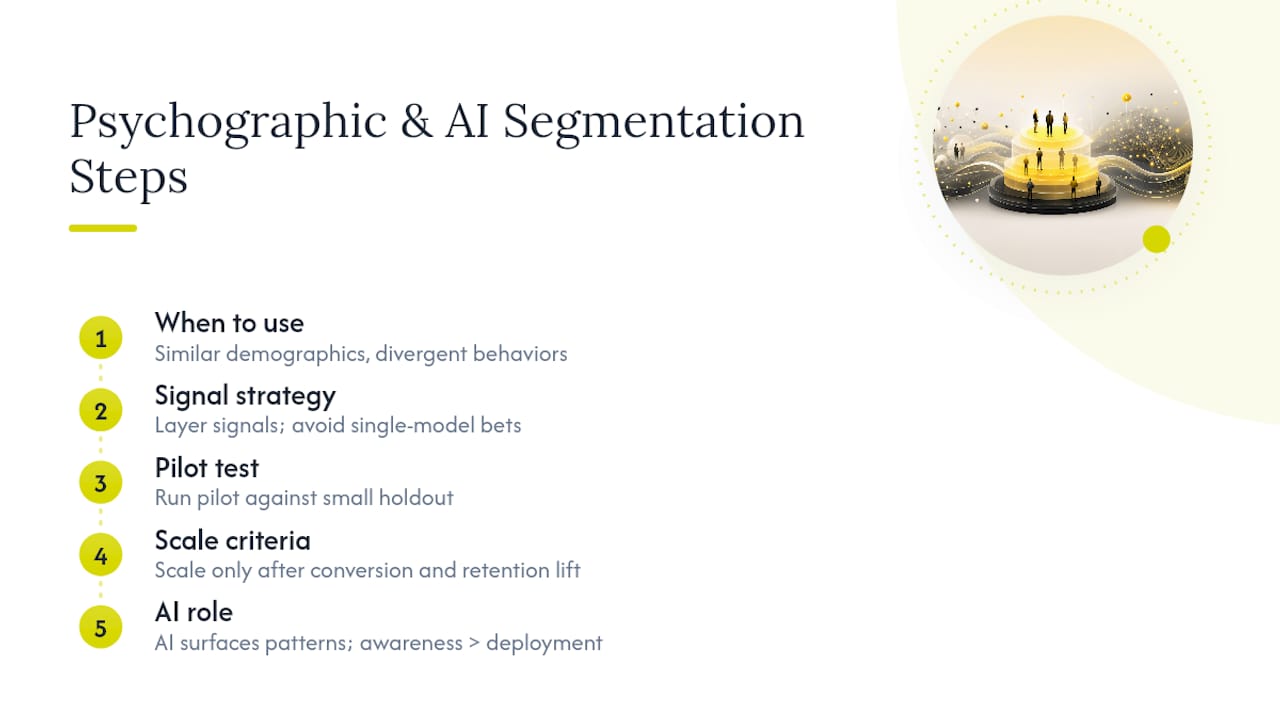
Psychographic segmentation pays off fastest when your audience is demographically homogeneous but behaviorally split, or when the offer itself is emotionally or creatively sensitive. A sustainability brand selling to shoppers who all fall in the same age and income bracket gains nothing from more demographic slicing; the real difference lives in values and motivation.
We layer signals in stages rather than betting everything on one psychographic model upfront. A pilot segment runs against a small holdout first, then scales only once positive results appear clearly. AI tools increasingly help surface these patterns automatically, though Acxiom’s research on psychographic versus behavioral segmentation points out that awareness of AI-driven segmentation is rising faster than actual deployment. Before operationalizing any segment, we want to see conversion lift and retention movement, not just a compelling story about who the segment contains.
— Vain.
Get Expert Help Building Segments That Convert
Building segments is one thing. Turning them into creative that actually performs across email, paid, and content is where most in-house teams run out of bandwidth. Vainnewyork works as a creative consultancy for brands that need audience research and segmentation done right the first time, without hiring a full internal analytics team.
A typical engagement gets you clearly defined segments backed by real behavioral and psychographic data, a test plan with holdout groups built in from the start, and a creative brief that maps specific messaging to each segment instead of one generic campaign stretched thin. If you already have a content engine but need the audience strategy behind it sharpened, Vain.'s audience development framework shows how segmentation feeds long-term growth rather than a single campaign burst. Ready to see what your own segments look like on paper? Visit Vainnewyork to start a conversation about your next audience research project.
Sources
For deeper technical grounding, review Matomo’s guide to the eight main segmentation types and Vain.'s piece on building an audience that converts.
Recommended
Comments