Audience Research Methods: A Practical Guide for Marketers


Start with the decision you’re trying to make, not the method you already like. Run one qualitative session to discover the “why,” then validate what you learn with a short quantitative survey, and never act on either alone. Every reliable audience research program follows this sequence: discover, validate, triangulate.
Do these three things this week:
Name the specific decision the research needs to inform (a headline, a pricing tier, a new feature).
Schedule one 30 to 45 minute interview with a real customer or prospect.
Draft six confirmatory survey questions built from what that interview reveals.
The IMS audience research pack recommends triangulating findings across methods before folding them into operational decisions. Skip that step, and you’re just decorating a guess with data.
Key Takeaways
Effective audience research pairs one qualitative discovery method with one quantitative validation method, then triangulates the results before any decision gets made.
Point | Details |
Start with the decision | Name the specific choice and success metric before picking a research method. |
Discover first, validate second | Run 8 to 12 interviews, then a survey of 100 or more respondents to confirm patterns. |
Never trust one method alone | Pair stated preference (surveys) with revealed behavior (analytics or observation). |
Rank findings by impact | Score insights on frequency times business impact to prioritize what gets built. |
Vain. runs the full cycle | Vain. delivers a research plan, an insight brief, and a creative test built from real audience data. |
Table of Contents
What audience research methods actually deliver
Audience research splits into two data types. Primary data comes from people you talk to or observe directly, through interviews, surveys, or usability sessions. Secondary data comes from sources that already exist, like industry reports, competitor content, or Census figures.
Good audience research answers four questions: who your audience actually is, why they behave the way they do, how they make decisions, and who else influences that decision. That fourth question matters more than most marketing teams assume. Pulsar’s audience analysis framework has expanded to include community-based mapping, which uses network science to show how people cluster around shared interests rather than demographics alone.
Done well, audience research produces three concrete outcomes:
Messaging that uses the audience’s own words instead of internal jargon.
Reduced wasted media spend, because targeting reflects real behavior rather than assumption.
A prioritized product or content roadmap, ranked by what audiences actually ask for.
Skip this groundwork, and every downstream decision (creative, targeting, pricing) inherits the same blind spots.
Should you run qualitative or quantitative research first?
Qualitative research tells you what’s happening and why. Quantitative research tells you how many people it’s happening to. The decision rule is simple: use qualitative methods for discovery when you don’t yet know the right questions, and quantitative methods for validation once you have a hypothesis worth testing at scale.
If you can’t predict the answer choices for a survey, you’re not ready for a survey. Run interviews first.
If you already have a hunch and need a number to act on, skip straight to a survey or an A/B test.
If stakeholders disagree on which hunch is correct, run both, in that order, and let the data settle it.
On timelines and sample sizes, Mailshake’s guide to customer research suggests 8 to 12 interviews are usually enough to map the territory of a problem, followed by a survey of 100 or more respondents to confirm which patterns actually hold at scale. Interviews answer “why do people abandon this signup flow?” Surveys answer “what percentage of our list would pay $15 more for this tier?”
Pro Tip: Resist the urge to run a 500-person survey before you’ve talked to anyone. A handful of unstructured conversations almost always surface a signal a survey design would have missed entirely, because you don’t yet know what to ask.
Which audience research method fits your question?
No single method covers every angle, which is exactly why the strongest programs run several in parallel. The IMS resource pack catalogs eight core approaches, and Sparktoro’s practitioner guide adds several more grounded in day-to-day marketing work, including social listening and first-party data analysis.
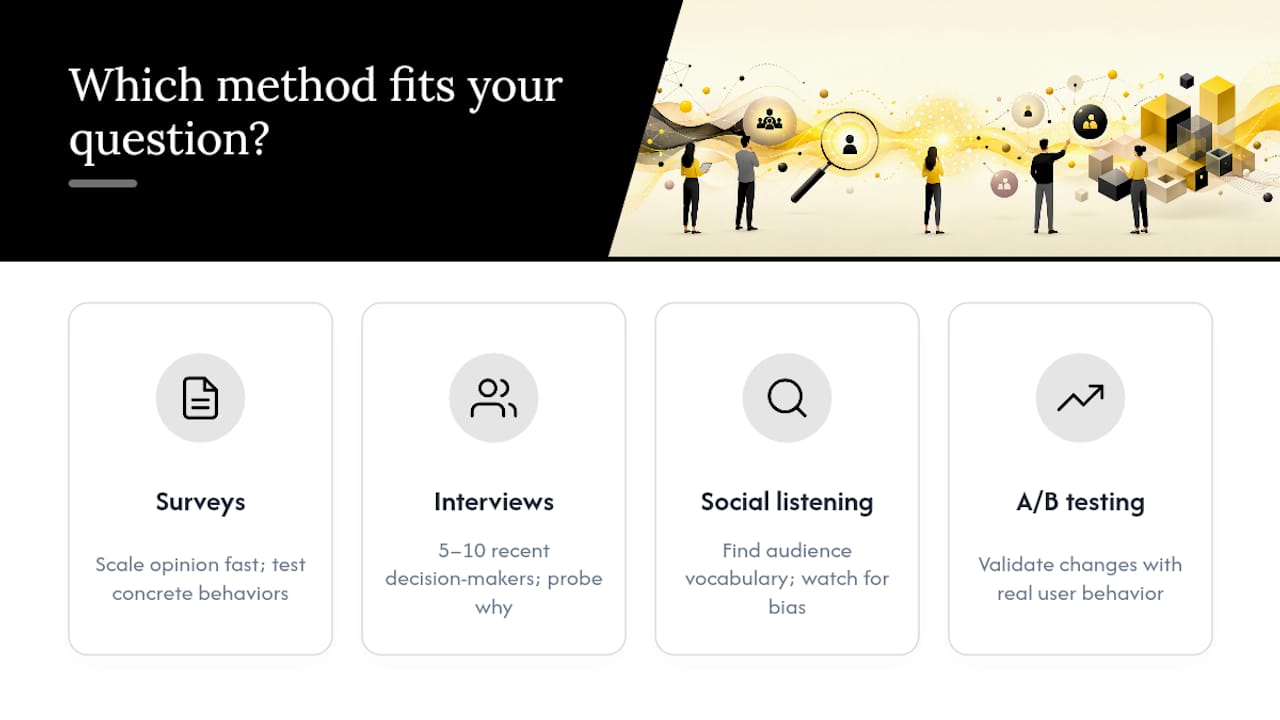
Surveys scale opinion data fast. Use them once you have specific hypotheses to test, and keep questions concrete: ask about a real recent behavior rather than a hypothetical future one. Scale sample size to the decision’s stakes. A minor headline test needs fewer responses than a pricing decision that touches your whole revenue model.
One-on-one interviews surface reasoning surveys can’t reach. Recruit five to ten people who recently made (or abandoned) the exact decision you’re studying, not a generic panel. Open with, “Walk me through the last time you tried to solve this problem,” and let silence do the work.
Focus groups and co-creation sessions work well for reacting to concepts, packaging, or messaging drafts. Their weakness is group bias: the loudest participant often drags the room toward their opinion. Counter this by collecting individual written reactions before group discussion begins.
Social listening reveals the vocabulary your audience actually uses, often diverging sharply from your internal language. It’s also skewed toward vocal minorities who post more than they represent, so Sparktoro’s guide recommends pairing it with survey or interview validation before trusting it as representative.
Analytics and behavioral data tell you what people did, not why. Trust it for conversion funnels and drop-off points; don’t trust it to explain motivation without a follow-up interview.
A/B testing validates specific message or interface changes with real behavior instead of stated preference. The IMS pack documents a publisher that saw a noticeable subscription lift purely from testing copy variations on a signup page, a reminder that small language changes carry outsized weight. A related approach to building an audience that converts walks through practical testing tactics for editorial and brand content.
Observations and usability tests, whether in-person or remote, expose friction people can’t articulate in an interview. Run these when you suspect the problem lives in the interface, not the message. A structured website audit is a useful model for what to measure during a session.
Personas should be built from the six methods above, not from a brainstorm. A persona built on real interview quotes and survey segments will hold up under scrutiny; one built on assumption will quietly mislead every team that uses it.
How do you run an audience research study step by step?
A repeatable workflow beats a one-off project every time, because the second and third rounds get faster and sharper.
Define the decision. Write the specific choice this research needs to inform, and the metric that will tell you if you made the right call.
Design the instrument. Draft an interview guide or survey with no leading questions; ask about past behavior, not future intent.
Recruit deliberately. Use a screener question to confirm each participant has actually experienced the situation you’re studying, not just a general interest in the topic.
Collect with consent. Record sessions only with explicit permission, and put your most important questions in the middle of the conversation, after rapport is built but before fatigue sets in.
Analyze systematically. Code transcripts by theme and sentiment, then count how often each theme appears and cross-reference it against behavioral data you already have.
Act on a brief, not a transcript. Summarize findings into a one-page insight brief with a clear recommendation and a proposed next experiment.
Offer a fair incentive for interview time. A $25 to $50 gift card is standard for a 30 to 45 minute session and improves both recruitment and honesty.
Keep the screener short enough that it doesn’t filter out the busy people whose time is most valuable to hear from.
How do you combine methods to reduce research risk?
Triangulation is the difference between a finding and a fact. The IMS pack frames this directly: combine qualitative discovery, quantitative validation, and behavioral evidence before treating any single result as reliable. A few pairings work especially well: interviews plus a confirmatory survey, social listening plus behavioral analytics, and usability observation plus an A/B test on the fix.
When stated preference (survey) and revealed behavior (analytics) disagree, trust behavior first, then interview a few people to understand why they said one thing and did another.
If two independent methods point the same direction, you likely have enough to act.
If they conflict and you can’t explain why, that’s the signal to run one more small study before committing budget.
Pro Tip: Contradictions aren’t failures. A gap between what people say and what they do is often the most valuable insight in the entire study, because it points straight at the messaging problem.
What tools and metrics should you track?
Match each method to a metric that proves it worked, not just that it happened. Response rate and completion time matter for surveys. Theme frequency and sentiment matter for interviews. Conversion lift and statistical confidence matter for A/B tests.
Surveys: free tools and paid platforms both work; track response rate and drop-off by question.
Analytics: GA4 covers on-site behavior at no cost, a starting point Axis Intelligence’s research guide recommends alongside Google Trends for search interest and the US Census Bureau for demographic baselines.
Listening and community mapping: social platforms and forums surface language; pair with Pulsar’s community-analysis approach for network-level clustering.
Recording and transcription: get written consent before recording any session, and store transcripts with participant identifiers stripped where possible.
What audience research mistakes should you avoid?
Most failed research projects share the same root problem: nobody could name the decision the study was supposed to inform. Fix that before touching any method.
No decision anchor. Write the decision and success metric before drafting a single question.
Sampling bias. Recruit outside your existing customer list occasionally, or you’ll only ever hear from people who already like you.
Leading questions. Replace “Don’t you think this feature would help?” with “How do you currently handle this problem?”
Social desirability bias. People overstate good habits and understate bad ones; weight behavioral data more heavily than self-reported behavior on sensitive topics.
Pro Tip: Rank findings using frequency times business impact. A complaint mentioned by ten people about a minor annoyance often matters less than one mentioned by three people about why they churned.
When should you use diary studies and longitudinal tracking?
Some behavior doesn’t show up in a single interview or a one-time survey because it unfolds over weeks, not minutes. Diary studies solve this by asking participants to log their experience in short, regular entries, typically for one to four weeks, capturing decisions and reactions close to when they actually happen rather than reconstructed from memory.
Diary studies work especially well for habitual purchases, subscription decisions, and any behavior with a delayed emotional payoff, like a fitness app or a financial planning tool. A participant who logs their reaction to a product each evening gives you a far more honest account than the same person trying to summarize a month of use in a single retrospective interview, where recency bias skews everything toward the last few days.
Longitudinal tracking extends this idea across an entire customer relationship. Instead of one snapshot, you’re watching how sentiment, usage, and stated needs shift over months or years. This matters most for products with long consideration cycles or subscription models where churn risk builds slowly before it becomes visible in a single data point.
The practical trade-off is participant fatigue. Diary studies and longitudinal panels ask for sustained attention, so incentive structure matters more here than in a one-time interview. Consider a small recurring reward tied to consistent logging rather than one lump payment, and keep each entry short enough that filling it out takes two minutes, not twenty. Recruitment should also skew toward participants who’ve shown reliability in past studies, since dropout midway through a four-week diary undermines the whole dataset.
How do you use secondary data and existing research?
Not every question needs a new study. Secondary data, research that already exists from government agencies, industry associations, or your own past projects, often answers a question faster and cheaper than fielding something new.
Government sources like the US Census Bureau provide free demographic baselines that would cost thousands to replicate through primary research. Google Trends shows search interest shifts over time at no cost, useful for spotting seasonal patterns before you commit budget to a campaign. Axis Intelligence’s guide to audience research lists these alongside social forums and free survey tools as a practical starting toolkit for teams without a large research budget.
Industry reports and competitor content analysis fall into this category too. If a trade association has already surveyed your exact market segment on pricing sensitivity, re-running that survey wastes budget you could spend on a question nobody has answered yet. A quick read of media and entertainment industry trend data can shortcut months of independent research on where audience attention is shifting.
The catch with secondary data is fit. A report built for a different market segment, geography, or time period can mislead you if you treat its conclusions as directly transferable. Always check the original sample and methodology before citing a secondary finding as fact, and use it to sharpen your primary research questions rather than replace them entirely. The strongest research programs treat secondary data as the first pass, not the final word, then spend primary research budget only on the gaps secondary sources leave open.
What does ethnographic research reveal that surveys can’t?
Ethnographic research means observing people in their actual environment, a home, a store, a workplace, rather than asking them to describe that environment to you afterward. The gap between the two is often larger than researchers expect.

People are unreliable narrators of their own behavior, not out of dishonesty but because most decisions happen on autopilot. Someone might tell you they carefully compare prices before buying groceries, then you watch them grab the same three brands out of habit without a glance at the shelf tag. Field observation catches that gap. It’s especially valuable for understanding context: how a product fits into a daily routine, what physical or social friction exists around a purchase, and which competing priorities crowd out the behavior you’re studying.
Running a field observation doesn’t require elaborate staging. A researcher shadowing a small business owner for half a day, or sitting quietly in a retail space watching how customers actually navigate it, produces more texture than a dozen structured interviews about the same environment. The technique works best paired with a short interview immediately after the observation, asking the person to explain choices you just watched them make while the reasoning is still fresh.
The limitation is scale. Ethnographic research is slow and resource-heavy, so it rarely makes sense as your primary method. Reserve it for high-stakes decisions where understanding context matters more than counting responses, like redesigning a physical retail experience or understanding why a product fails to fit into an established daily routine. Pair a handful of field sessions with a validating survey once a pattern emerges, the same discovery-then-validate rule that governs every other qualitative method in this guide.
How do you handle privacy and ethics in audience research?
Every research method in this guide involves collecting information from real people, which means consent and data hygiene aren’t optional add-ons. They’re part of the method.
Get explicit permission before recording any interview or focus group, and say plainly how the recording will be used and how long you’ll keep it. Strip identifying details from transcripts before sharing them across a team, especially for sensitive topics like financial behavior or health decisions. If you’re running a survey that touches personal data, state clearly what you’ll do with responses and give participants a real way to decline without losing access to a product or service.
Incentives deserve the same scrutiny. A gift card or cash payment for interview time is standard practice and generally appropriate, but an incentive large enough to distort honest answers, or one aimed at a vulnerable population who might feel pressured to participate, crosses a line. Keep incentives proportional to the time asked and never contingent on giving a particular answer.
Diary studies and longitudinal tracking raise the stakes further, since you’re holding personal data over weeks or months rather than a single session. Set a clear deletion timeline and stick to it. Social listening sits in a gray area many teams overlook: public posts are visible, but quoting an individual by name in an internal report without their knowledge still feels invasive to most people if they found out. When in doubt, aggregate and anonymize rather than attribute.
How do you turn research findings into a decision?
A pile of interview notes and survey exports isn’t an insight. An insight brief is a short document that states what you found, why it matters, and what to do next, and it’s the actual deliverable of every research project, not the raw data behind it.
Structure the brief around the decision you named at the start of the study, not around the methods you used to answer it. Lead with the recommendation, then back it with the two or three strongest pieces of evidence, mixing a quote or two with the behavioral or survey data that confirms it holds at scale. Mailshake’s approach to prioritizing findings works well here: tag each insight by theme and sentiment, then rank by frequency times business impact so stakeholders see immediately which findings deserve budget and which are interesting but low stakes.
Resist the temptation to present every theme that surfaced. A brief with fifteen findings gets none of them acted on; a brief with three gets all three tested. Close with a specific next experiment, not a vague call to “keep monitoring,” so the research has a clear next step someone on the team actually owns.
Visuals help more than most marketers assume. A simple two-by-two chart plotting frequency against impact turns a wall of quotes into something a non-researcher can scan in thirty seconds and act on in the next planning meeting.
Vain.'s applied view: running research that leads to creative action
We treat audience research as the front half of creative work, not a separate function that hands off a report and disappears. A short interview round tells us what language actually lands; a follow-up survey confirms it holds beyond the handful of people we talked to; the resulting brief becomes the brief for the next campaign or content push, not a filed document nobody revisits.
That loop, research to insight to creative action, is the same discipline behind our 90-day marketing analytics playbook, and it’s why we push clients toward small, repeatable studies over one massive annual survey.
— Vain.
How Vain. helps you run audience research that leads somewhere
Vain. runs the full research cycle so the output isn’t a slide deck that sits in a shared drive. We handle the planning, recruit real participants who match your screener instead of a generic panel, do the analysis and coding, and turn the findings into a creative test your team can actually run. A typical engagement produces a research plan, one insight brief ranked by frequency and business impact, and a creative test built directly from what your audience told us.
If you’ve read this far and know your audience research needs a second set of hands, or a first structured attempt, start a conversation with Vain. about what a discovery phase would look like for your team. Bring the decision you’re trying to make, and we’ll help you build the study that answers it.
Sources
Recommended
Comments